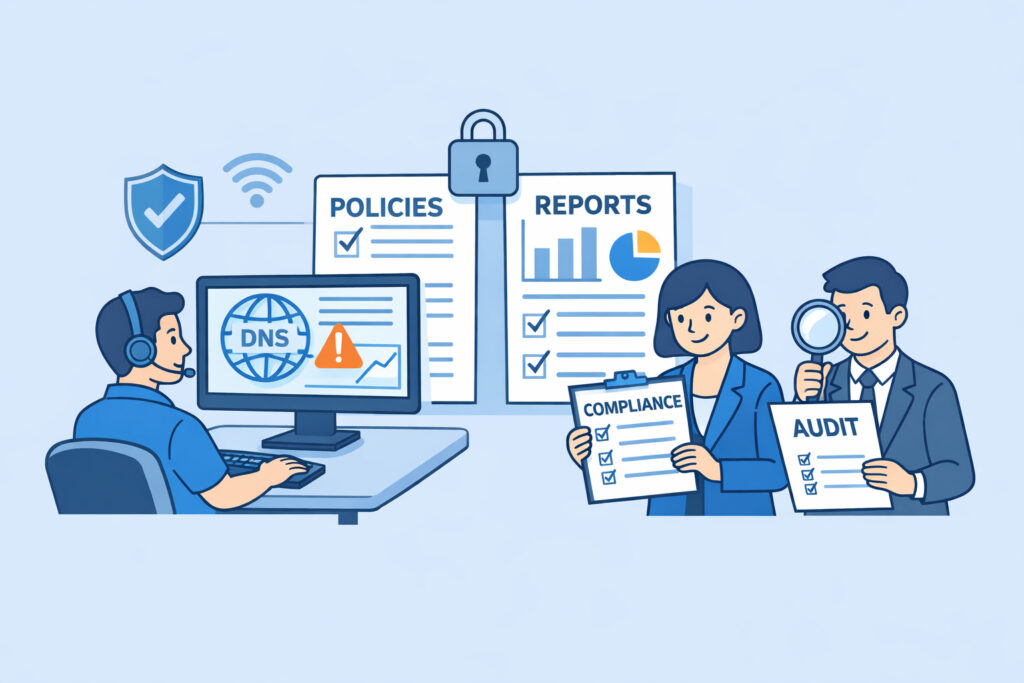
DNS monitoring plays a critical role in meeting compliance and audit requirements that many organizations overlook until it’s too late. If you manage infrastructure subject to regulatory frameworks – whether PCI DSS, SOC 2, HIPAA, or ISO 27001 – your DNS configuration is part of your attack surface, and auditors know it. Understanding how continuous DNS monitoring maps directly to compliance controls can save you from failed audits, costly remediation, and the kind of findings that keep security teams up at night.
Why Auditors Care About Your DNS
Most compliance frameworks don’t mention DNS by name in every control. But they all require you to maintain an accurate asset inventory, detect unauthorized changes, and protect against common attack vectors. DNS sits at the intersection of all three.
Think about it from an auditor’s perspective. They ask for a complete list of your internet-facing assets. You hand over a spreadsheet you last updated six months ago. Meanwhile, a developer spun up a staging subdomain in February, the marketing team launched a campaign microsite in March, and nobody decommissioned the old partner portal that still has a CNAME pointing to a cancelled cloud service. Your asset inventory is already wrong – and the audit hasn’t even started.
This is not a hypothetical scenario. It happens in nearly every organization with more than a handful of subdomains. The gap between what you think exists and what actually exists in your DNS is where compliance failures hide.
Mapping DNS Monitoring to Compliance Controls
Let’s break down how DNS monitoring directly supports specific compliance requirements.
Asset inventory and management. PCI DSS Requirement 2, SOC 2 CC6, and ISO 27001 Annex A.8 all require organizations to identify and manage their information assets. Automated DNS health checks give you a continuously updated view of every domain and subdomain under your control – including the ones nobody remembers creating.
Change detection and monitoring. Nearly every framework requires you to detect unauthorized changes to your environment. DNS record modifications – whether a changed MX record, a new A record, or an altered SPF entry – are changes to your infrastructure. Without monitoring, these changes happen silently.
Vulnerability management. Stale DNS records pointing to decommissioned services are vulnerabilities. A dangling CNAME is not just a configuration oversight – it’s an exploitable weakness. Compliance frameworks like PCI DSS Requirement 6 and SOC 2 CC7 require you to identify and address vulnerabilities in a timely manner.
Email security controls. SPF, DKIM, and DMARC records are DNS-based controls that protect against email spoofing and phishing. Multiple frameworks now expect organizations to implement and maintain these records. Monitoring ensures they stay correctly configured across all your domains – not just your primary one.
The Audit Evidence Problem
Here’s something I’ve seen trip up even well-prepared teams: having the controls in place isn’t enough. You need to prove they were in place continuously.
An auditor doesn’t just want to see that your DNS is correctly configured today. They want evidence that you’ve been monitoring it consistently, that you detected and responded to issues within defined timeframes, and that you have historical records showing the state of your infrastructure over the audit period.
Manual DNS audits performed quarterly or even monthly leave gaps. What happened between checks? Can you prove nothing changed? With continuous monitoring through a platform like DNSVigil, you get timestamped records of your DNS state, alerts for any changes, and a clear audit trail showing when issues were detected and resolved. That’s the kind of evidence that makes audits go smoothly.
Building a Compliance-Ready DNS Monitoring Practice
If you’re starting from scratch or improving an existing setup, here’s a practical approach:
Step 1 – Discover everything first. You can’t monitor what you don’t know about. Run a full subdomain enumeration and DNS audit to establish your baseline. This becomes your authoritative asset inventory for DNS.
Step 2 – Define what “compliant” looks like. Document your expected DNS configuration for each domain and subdomain. This includes which record types should exist, what values they should hold, and which email authentication records are required. This becomes your compliance baseline.
Step 3 – Enable continuous monitoring. Set up automated monitoring that checks your DNS against your baseline and alerts on any deviation. This covers the change detection requirements most frameworks demand.
Step 4 – Establish response procedures. Define how your team responds to DNS alerts. Who investigates? What’s the acceptable response time? Document this – auditors love documented procedures backed by actual alert history.
Step 5 – Retain evidence. Keep monitoring logs, alert histories, and resolution records for the full audit period. Most frameworks require 12 months of evidence at minimum.
Following DNS security best practices isn’t just good hygiene – it’s directly mapped to the controls auditors evaluate.
The Myth: “DNS Is Just Infrastructure, Not a Compliance Concern”
This is probably the most dangerous misconception in IT compliance today. Teams treat DNS as plumbing – something that just works in the background. But DNS misconfigurations have led to data breaches, email compromise, and subdomain takeover attacks that directly violate compliance requirements.
When a forgotten subdomain gets taken over and serves malware to your customers, that’s a security incident. When your SPF record is misconfigured and someone spoofs your CEO’s email address, that’s an email security failure. Both generate audit findings. Both could have been prevented with proper DNS monitoring.
Auditors are increasingly DNS-literate. They know to ask about subdomain management, dangling records, and email authentication. Walking into an audit without visibility into your full DNS footprint is a risk you don’t need to take.
FAQ
Which compliance frameworks specifically require DNS monitoring?
No major framework requires “DNS monitoring” by those exact words. However, PCI DSS, SOC 2, ISO 27001, HIPAA, and NIST CSF all contain controls around asset management, change detection, and vulnerability management that DNS monitoring directly supports. The requirement is implicit – you need to monitor your internet-facing infrastructure, and DNS is a fundamental part of that.
How often should DNS be monitored for compliance purposes?
Continuous monitoring is the standard expectation for most modern compliance frameworks. Quarterly manual audits are no longer sufficient on their own. Automated monitoring that runs daily or more frequently – combined with real-time alerting on changes – meets the spirit and letter of most compliance requirements. Keep your DNS security checklist updated alongside your monitoring schedule.
What DNS monitoring evidence do auditors typically request?
Auditors commonly ask for a complete inventory of domains and subdomains, evidence of continuous monitoring over the audit period, records of detected changes and how they were resolved, documentation of email authentication records (SPF, DKIM, DMARC) across all domains, and proof that stale or orphaned DNS records are identified and removed. Having this evidence readily available through automated monitoring dramatically reduces audit preparation time.
The bottom line is straightforward: DNS monitoring isn’t an optional add-on to your compliance program – it’s a foundational control that supports multiple requirements across virtually every major framework. Start with full visibility into your DNS footprint, maintain continuous monitoring, and keep the evidence. Your next audit will thank you.