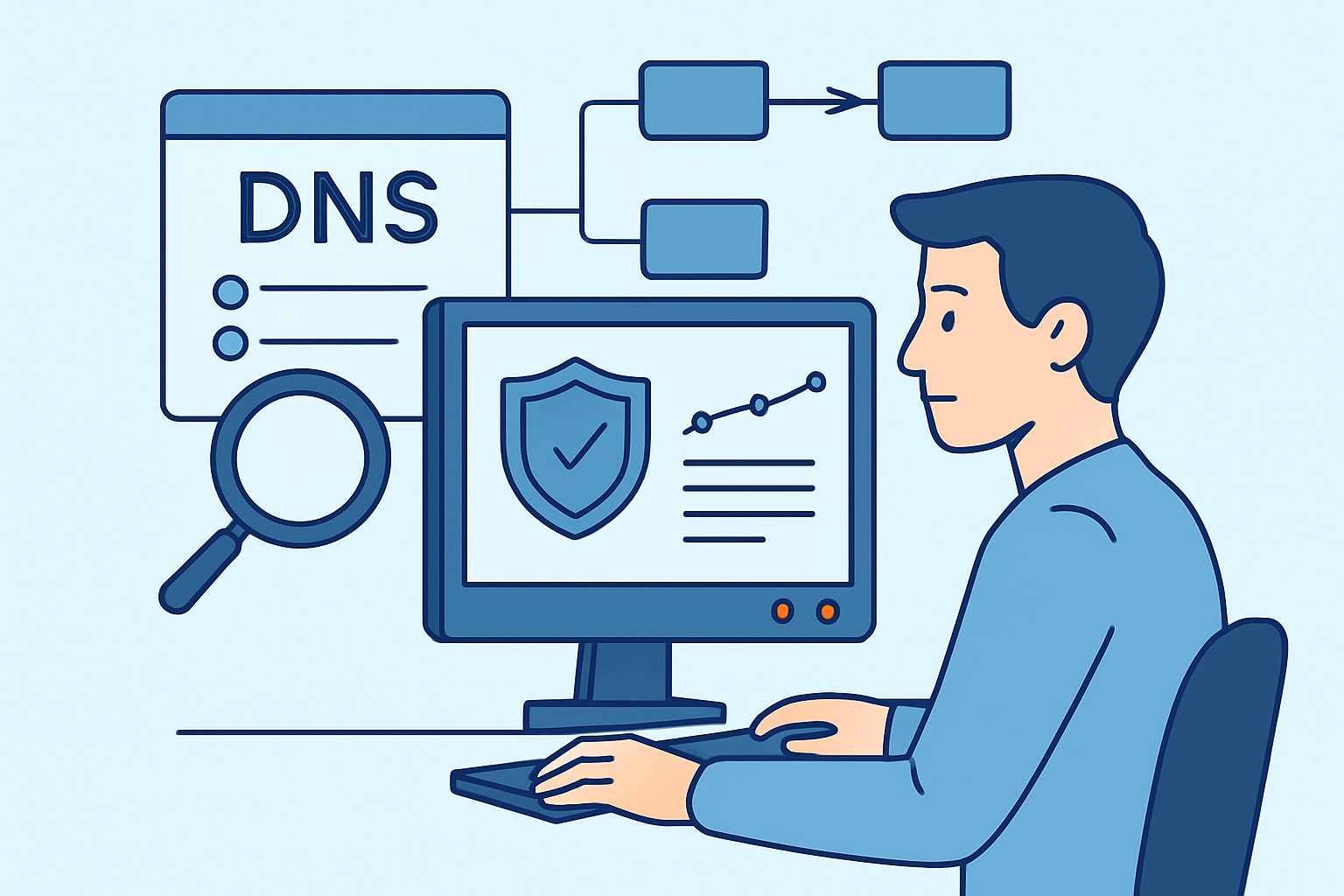
Security teams spend enormous effort tuning their SIEM to catch lateral movement, failed logins, and malware beacons, yet DNS traffic – arguably the most information-dense log source in the entire stack – often gets piped in as a low-priority feed nobody actually reviews. Integrating DNS monitoring into your SIEM workflow properly means treating subdomain health, DNS record changes, and resolution anomalies as first-class security telemetry rather than background noise.
Why DNS Data Belongs in Your SIEM
There’s a persistent myth in security operations that DNS logs are only useful for network troubleshooting – slow resolution, misconfigured resolvers, that kind of thing. That’s outdated thinking. Every C2 callback, every phishing redirect, every subdomain takeover attempt leaves a DNS fingerprint before it ever shows up in an EDR alert or a firewall log.
The problem isn’t that DNS data lacks value. It’s that most SIEM deployments only ingest raw query/response logs from resolvers, which tells you what was looked up but nothing about whether the DNS infrastructure itself is healthy. A record silently pointing to a decommissioned cloud bucket won’t trigger a single query-log anomaly until an attacker actually claims it.
What DNS Signals Actually Matter to a SOC Analyst
Query logs are only half the picture. The other half – the part most SIEM pipelines miss entirely – is the state of your own DNS records over time. That includes:
Newly created or modified A, CNAME, and MX records that weren’t tied to a change ticket. Subdomains resolving to IP ranges or cloud services no longer under your control. Sudden disappearance of SPF, DKIM, or DMARC entries on a domain that previously had them. TTL values dropping sharply right before a record change, which frequently precedes hijacking attempts or unauthorized takeovers.
None of this comes from a resolver log. It comes from continuously monitoring your own authoritative DNS zone and comparing it against a known-good baseline. That’s the piece worth feeding into correlation rules, because a dangling CNAME combined with a spike in external queries to that same subdomain is a much stronger signal than either event alone.
Getting the Feed Into Your SIEM
The mechanics are straightforward once the source data is reliable:
Export DNS health events as structured JSON or syslog – record changes, new subdomains discovered, SPF/DKIM/DMARC status changes, and resolution failures should each carry a timestamp, asset identifier, and severity tag. Map these events to existing asset inventory fields in the SIEM so a subdomain alert lands against the same asset record as your vulnerability scan data, not as an orphaned log line. Build correlation rules that pair DNS state changes with other telemetry – a new CNAME pointing to a third-party service combined with an unexpected certificate issuance for that hostname is worth an automatic ticket, not just a log entry. Set retention long enough to catch slow-moving attacks; subdomain takeovers can sit dormant for months between the DNS record going stale and someone actually claiming the resource.
Most teams skip the asset-mapping step, and it’s the one that determines whether analysts trust the feed or start filtering it out. An alert that just says “CNAME changed on sub47.example.com” with no ownership context gets ignored by the third week.
Where This Usually Goes Wrong
The most common mistake is treating DNS monitoring as a compliance checkbox rather than an operational feed. Teams stand up a scan, dump results into a dashboard nobody checks, and move on. When a real incident happens – a forgotten marketing subdomain gets claimed on a cloud provider and starts serving malicious content – the DNS evidence was sitting in a report from three weeks earlier that never made it into an actual alert.
The second mistake is alert fatigue from ingesting raw DNS query volume without any health-state filtering. If your SIEM is drowning in millions of routine lookups, analysts will tune out the feed entirely, including the handful of events that actually matter. Feeding curated DNS health events – state changes, missing authentication records, ownership mismatches – rather than raw query firehoses keeps the signal-to-noise ratio workable. This is exactly the kind of prioritization worth building into security dashboards built around DNS health metrics, so analysts see trend lines instead of individual packets.
A Realistic Scenario
Picture a mid-sized SaaS company running a quarterly product demo campaign. A subdomain gets spun up on a cloud load balancer, used for six weeks, then abandoned when the campaign ends – but the CNAME record is never removed. Four months later, the cloud provider reassigns that IP range to a new customer. Anyone can now provision a resource matching the dangling CNAME and serve content under the company’s own domain.
If DNS state monitoring feeds into the SIEM, this shows up as a record pointing to a now-deallocated cloud resource, flagged the week the campaign ended – not four months later when someone actually exploits it. Without that feed, the first sign of trouble is a customer reporting suspicious content on what looks like an official subdomain. Knowing precisely which DNS alerts to watch and when to escalate them is what separates a quiet remediation ticket from an incident response scramble.
FAQ
Does DNS monitoring duplicate what my firewall or EDR already logs?
No. Firewalls and EDR tools see traffic and endpoint behavior; they don’t tell you when your own authoritative DNS records go stale or point somewhere you no longer control. That state information only comes from monitoring the zone itself.
How often should DNS health data be correlated against other SIEM sources?
Continuously, not on a scheduled batch job. Record changes and subdomain discovery events should trigger correlation rules in near real time, since the gap between a record going stale and it being exploited can be measured in days.
Is this only relevant for large enterprises with big security teams?
No. Smaller organizations with limited SOC staff arguably benefit more, since they can’t afford to manually audit DNS zones on a recurring basis. Automated feeds compensate for the headcount gap, and this is one of the areas CISOs evaluating DNS infrastructure risk tend to underestimate until an incident forces the conversation.
Getting DNS monitoring into the SIEM isn’t about adding another data source for the sake of coverage metrics. It’s about closing a blind spot that traditional log sources were never designed to see – the health and ownership status of your own DNS records, tracked continuously enough that the SOC finds out about a problem before an attacker does.