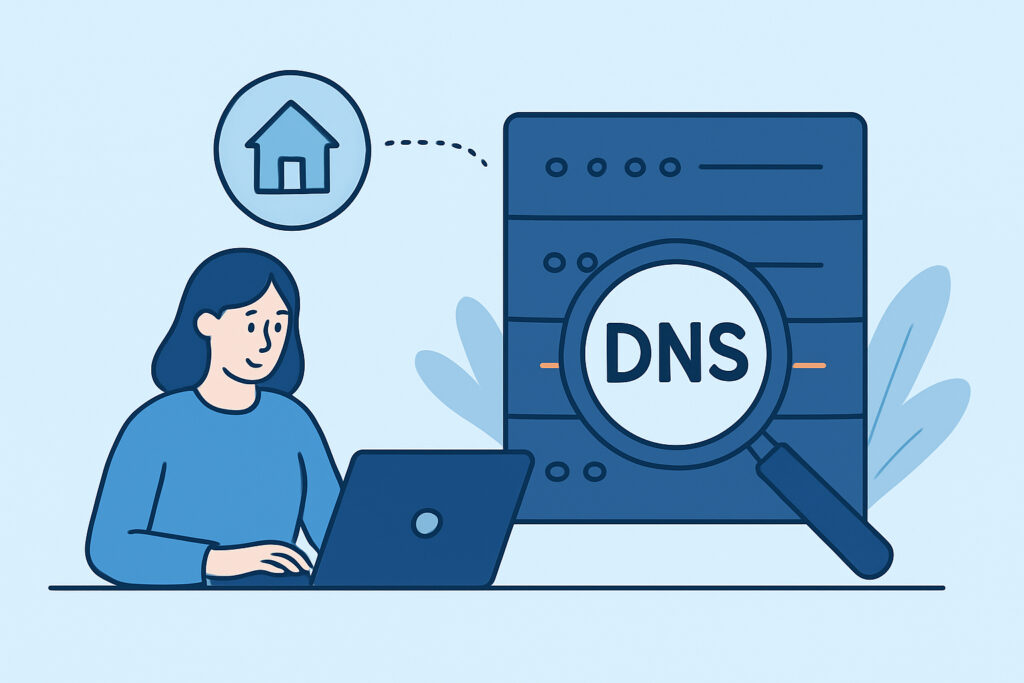
Remote-first companies run their infrastructure differently than offices ever did – engineers spin up staging environments from home networks, contractors get temporary subdomains for client demos, and nobody sits down the hall to ask “hey, do we still need this?” That’s exactly why DNS monitoring for remote-first organizations has become less of a nice-to-have and more of a baseline requirement: distributed teams create DNS records faster than they clean them up, and without centralized oversight, those records quietly turn into attack surface.
This article breaks down what makes DNS risk different in a remote-first setup, what to actually monitor, and how to build a process that doesn’t rely on everyone remembering to email IT before they spin up a new subdomain.
Why Distributed Teams Create More DNS Sprawl
In a traditional office, infrastructure changes tend to funnel through a handful of people who know the DNS zone by heart. Remote-first teams don’t work that way. Marketing spins up a landing page subdomain through a SaaS tool, a contractor points a CNAME at a demo environment, and a developer working from a coffee shop provisions a quick test subdomain that never gets torn down after the sprint ends.
None of this is malicious. It’s just what happens when domain administration gets spread across time zones, tools, and people who each have legitimate reasons to touch DNS but no shared visibility into what everyone else is doing. Six months later, nobody remembers who created dev-payments.example.com or whether the cloud service it points to is still active.
The Subdomain Takeover Risk Nobody’s Watching
The most concrete danger in this environment is subdomain takeover. It happens when a DNS record – usually a CNAME – still points to a third-party service (a hosting platform, a CDN, a SaaS app) that your organization no longer controls, because the underlying resource was deleted or the subscription lapsed.
If an attacker registers that same resource name on the provider’s platform, the DNS record still resolves, but now to infrastructure the attacker owns. From there they can serve phishing pages, harvest credentials, or run malware – all under your organization’s legitimate domain name, which bypasses a lot of the trust filters browsers and users normally apply.
Remote-first teams are especially exposed because temporary environments – staging apps, demo sites, one-off marketing pages – get built quickly on cloud platforms and torn down just as quickly, but the DNS record pointing at them often survives the cleanup. A departing contractor is a common trigger too: they leave, their trial account on some hosting service expires, and the subdomain they set up during onboarding sits there dangling for anyone to claim.
What to Monitor Beyond Uptime Checks
Uptime monitoring tells you if a site is reachable. It says nothing about whether the underlying DNS configuration is safe. For remote-first organizations, a monitoring approach needs to cover:
Subdomain inventory – a current, automatically updated list of every subdomain tied to your primary domain, not a spreadsheet someone updates twice a year.
Dangling records – CNAMEs, A records, and NS records pointing to resources that no longer exist or are no longer owned by your organization.
Email authentication – SPF, DKIM, and DMARC records, since a missing or misconfigured SPF record makes it trivially easy for someone to spoof email from your domain.
Unexpected changes – any modification to existing DNS records that wasn’t part of a planned deployment, which is often the first sign of a hijacked registrar account or a rogue integration.
Manually reviewing all of this across dozens of tools and team members isn’t realistic for most distributed teams. This is where automated discovery matters: a service that continuously scans for subdomains and checks their DNS health catches the test environment that got spun up last Tuesday, not just the ones on your original list.
Building a Process That Survives Team Turnover
The technical monitoring only works if it’s paired with a process. A few practices that hold up well in distributed environments:
Require that any new subdomain gets logged somewhere central at creation time, even if that’s just a shared ticket, not after the fact. Tie subdomain cleanup into offboarding checklists, since departing employees and contractors are one of the most common sources of orphaned DNS records. Review third-party integrations quarterly, because SaaS tools that once needed a CNAME often keep the DNS record long after the account was cancelled. And treat DNS the way you’d treat access management – something with an owner, not something that lives in a shared registrar login nobody fully understands.
Organizations scaling their remote workforce quickly tend to feel this gap first, since headcount growth usually outpaces DNS governance. It’s worth looking at how DNS security holds up during rapid team scaling if your organization is adding people faster than it’s adding process.
A Common Myth Worth Retiring
A persistent misconception is that DNS security is purely an infrastructure or networking concern, separate from day-to-day engineering work. In a remote-first company, that division doesn’t hold. Every engineer who deploys a preview environment, every marketer who launches a campaign microsite, and every ops person who connects a new SaaS tool is making a DNS decision, whether they realize it or not.
Treating DNS as “someone else’s job” is precisely how dangling records accumulate. It’s part of why DevOps teams increasingly own DNS security directly rather than routing every change through a separate infrastructure group – the people creating the records are best positioned to also be accountable for cleaning them up.
Watching for Shadow IT in a Distributed Workforce
Remote teams also lean more heavily on tools that never go through a formal procurement process. Someone signs up for a free trial of a hosting or forms platform, connects it to a subdomain to test something, and that connection outlives the trial. This is a specific flavor of shadow IT, and it’s one of the quieter ways distributed organizations end up with DNS records they don’t remember approving. Understanding how shadow IT creates hidden DNS security risks is a useful next step for teams trying to map where these unmanaged connections tend to originate.
Frequently Asked Questions
How often should a remote-first organization audit its DNS records?
Continuous monitoring is more realistic than periodic audits for distributed teams, since new subdomains and third-party connections can appear at any time from anywhere. If continuous monitoring isn’t in place yet, a quarterly manual review is a reasonable minimum, with immediate review triggered by employee or contractor offboarding.
Does DNS monitoring replace the need for a VPN or endpoint security?
No. DNS monitoring addresses a different layer – the health and ownership of your domain’s DNS records – while VPNs and endpoint tools protect device and network access. Remote-first organizations typically need both, since neither covers the gaps left by the other.
Can a small distributed team really keep up with subdomain sprawl without dedicated staff?
Yes, but not through manual tracking alone. Automated subdomain discovery and DNS health checks do the continuous watching that a small team doesn’t have hours for, leaving people to review alerts and make ownership decisions rather than hunt for problems from scratch.
Remote-first doesn’t have to mean DNS blind spots. The organizations that handle this well aren’t the ones with the fewest subdomains – they’re the ones that know, at any given moment, exactly what every subdomain points to and why it’s still there.