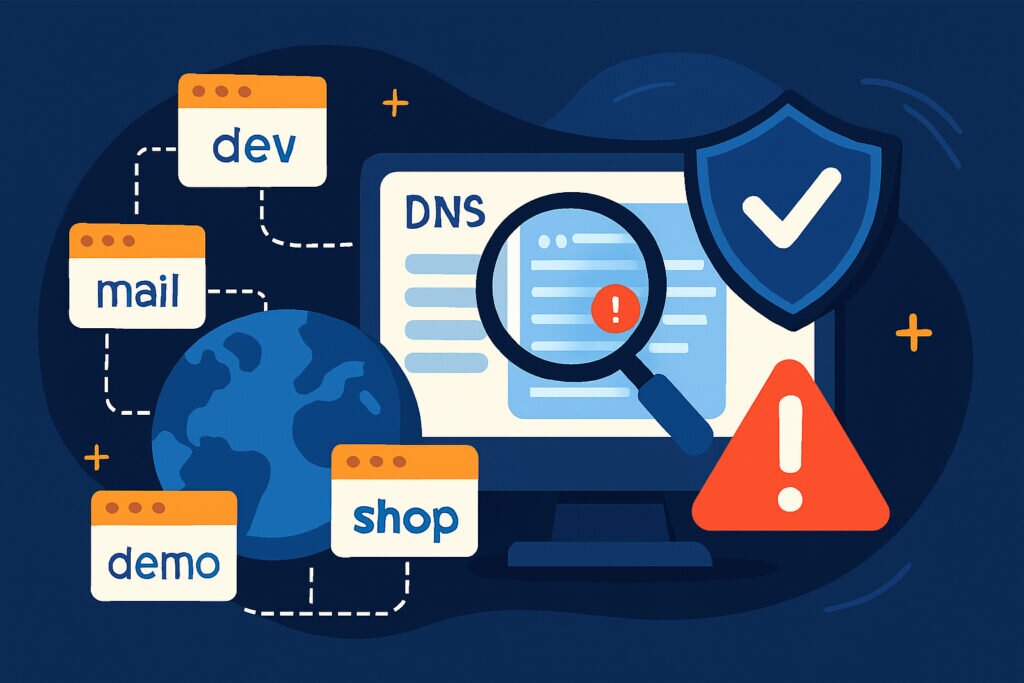
Most companies don’t realize they have a security problem until it’s too late. You set up a DNS record for a test environment, a marketing campaign, or a partner integration. Six months later, that project is forgotten, but the DNS record is still there, pointing to a server you no longer control. That’s when attackers strike.
I’ve seen this happen more times than I care to admit. A colleague once told me about a company that lost over $200,000 when hackers took over a forgotten subdomain and used it to phish their customers. The subdomain had been set up two years earlier for a product demo that never launched. Nobody remembered it existed until the damage was done.
The Hidden Danger in Your DNS Records
DNS is the phonebook of the internet, but unlike a real phonebook, it never gets updated unless you actively maintain it. Every time you create a new subdomain – whether it’s dev.yourcompany.com, blog.yourcompany.com, or old-campaign.yourcompany.com – you’re adding another potential entry point for attackers.
The problem is that digital infrastructure grows organically. Marketing creates landing pages. Developers spin up test environments. Partners get API endpoints. Over time, you end up with dozens or even hundreds of subdomains, and nobody has a complete picture of what exists.
When a developer leaves the company or a project gets cancelled, the servers might get shut down, but the DNS records often remain. These dangling DNS records are a goldmine for attackers. They can register the same cloud server name, IP address, or service that your DNS record points to, effectively hijacking your subdomain.
Real-World Attack Scenarios
Let me walk you through how these attacks actually happen. Say you had a subdomain api.yourcompany.com pointing to an AWS server for a partner integration. The partnership ended, you shut down the server, but forgot to delete the DNS record. An attacker notices this, spins up a new server with the same address, and suddenly they control api.yourcompany.com. They can now intercept API calls, steal credentials, or serve malware to anyone trying to access that endpoint.
Or consider email authentication. Many companies set up SPF and DKIM records when they configure email services, but if those services change or get discontinued, the DNS records might point to servers that no longer exist. Attackers can exploit these misconfigured records to send emails that appear to come from your domain, bypassing spam filters because your DNS records essentially vouch for them.
I once worked with a small e-commerce business that had this exact problem. They’d switched email providers but left the old SPF record in place. Scammers used it to send fake order confirmations that looked completely legitimate. The company only found out when customers started complaining about fraudulent charges.
Why Manual DNS Audits Fail
You might think the solution is simple: just review your DNS records regularly. In practice, this doesn’t work for several reasons.
First, DNS records are spread across multiple systems and managed by different teams. Your IT team knows about infrastructure records, marketing manages campaign subdomains, and developers create test environments. Nobody has the complete picture.
Second, manual checks are time-consuming and error-prone. Looking through hundreds of DNS records to identify which ones are outdated or potentially dangerous is tedious work. It’s exactly the kind of task that gets postponed until “next quarter” and then forgotten entirely.
Third, DNS problems don’t announce themselves. A dangling DNS record doesn’t trigger any alerts. Everything looks fine until an attacker exploits it.
How Automated DNS Monitoring Works
Proper DNS monitoring continuously scans your entire DNS infrastructure and alerts you to problems before they become security breaches. Here’s what it should do:
Discover all subdomains automatically. The system should find every subdomain associated with your main domain, including ones you might have forgotten about. This gives you a complete inventory of your digital footprint.
Verify DNS record health 24/7. Each record should be checked regularly to ensure it points to valid, active servers. If a record points to a non-existent server or service, you get an immediate alert.
Monitor for subdomain takeover risks. The system should specifically look for dangling DNS records that could be exploited by attackers – records pointing to deactivated cloud instances, deleted GitHub pages, or discontinued services.
Check email authentication. SPF, DKIM, and DMARC records should be verified to ensure they’re correctly configured and not pointing to servers you no longer control.
Track DNS changes. Any modifications to your DNS records should be logged and reported, so unauthorized changes get caught immediately.
The Real Cost of DNS Security Breaches
When DNS security fails, the consequences go far beyond the immediate technical problem. A successful subdomain takeover can lead to:
Data breaches when attackers intercept sensitive information sent to hijacked endpoints. Customer trust erosion when your domain is used for phishing or malware distribution. Regulatory fines if customer data is compromised through preventable DNS misconfigurations. Revenue loss when customers stop doing business with you after a security incident.
The average cost of a data breach now exceeds $4 million according to recent studies, and DNS-related vulnerabilities are increasingly common attack vectors. What makes this particularly frustrating is that these breaches are completely preventable with proper monitoring.
Common DNS Vulnerabilities to Watch For
Beyond dangling DNS records, several other DNS misconfigurations create security risks. Missing DNSSEC records leave your domain vulnerable to DNS spoofing attacks. Overly permissive SPF records allow spammers to abuse your domain. Wildcard DNS records that aren’t properly secured can be exploited to create unlimited malicious subdomains.
The challenge is that DNS is a “set it and forget it” technology for most organizations. You configure it once when setting up a service, and then it sits there forever. This works fine until your infrastructure changes, and then those forgotten records become security liabilities.
Making DNS Monitoring Practical
The key to effective DNS monitoring is automation and simplicity. You need a system that requires minimal setup, runs continuously in the background, and only alerts you when there’s an actual problem.
Start by getting a complete inventory of all your subdomains. You can’t secure what you don’t know exists. Then implement continuous monitoring that checks DNS record health and watches for takeover vulnerabilities. Make sure you’re getting alerts that are actionable – too many false positives and you’ll start ignoring them.
DNS security doesn’t have to be complicated or expensive. The important thing is having visibility into your entire DNS infrastructure and knowing immediately when something goes wrong. That one-time setup can save you from a six-figure security breach down the road.
Your DNS records are probably less secure than you think. The question is whether you’ll find the vulnerabilities before attackers do.