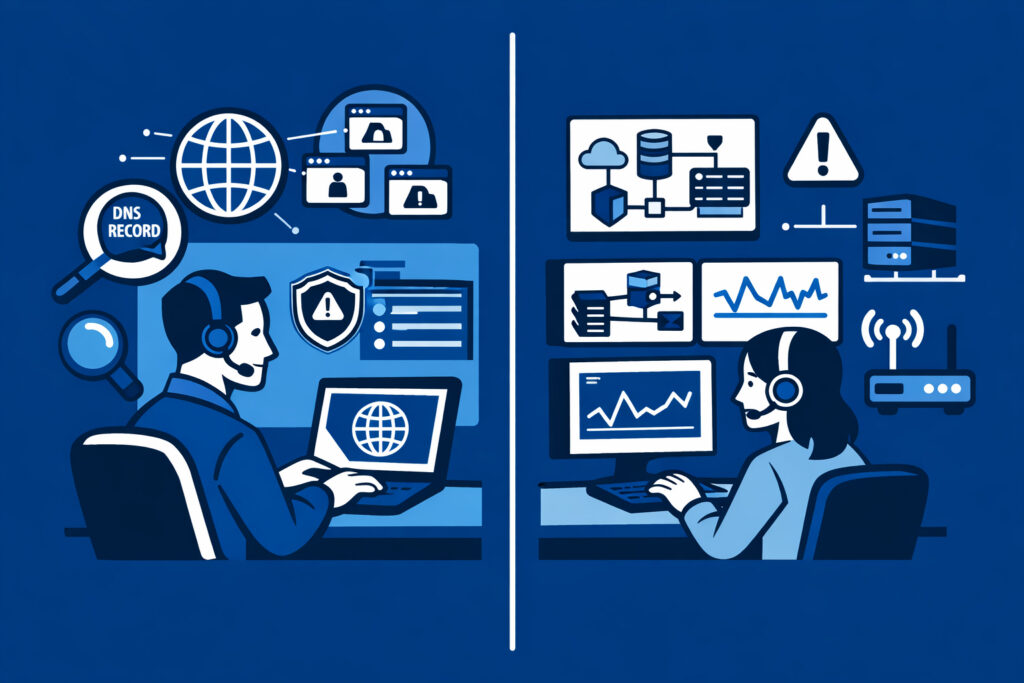
If you’re responsible for keeping infrastructure healthy, you’ve probably got dashboards tracking bandwidth, latency, packet loss, and server uptime. But here’s the question most teams don’t ask until something breaks: does your traditional network monitoring actually cover your DNS? Understanding the key differences between DNS monitoring and traditional network monitoring is critical, because the gaps between them are exactly where attackers and outages love to hide.
Traditional monitoring tools are excellent at telling you a server is down or a link is saturated. They’re terrible at telling you that someone’s forgotten subdomain just became a phishing page. These are fundamentally different disciplines, and treating them as interchangeable is one of the most common mistakes in modern IT operations.
What Traditional Network Monitoring Actually Covers
Traditional network monitoring — tools like Nagios, Zabbix, PRTG, or LibreNMS — focuses on infrastructure availability and performance. They monitor things like ICMP ping responses, port availability, bandwidth utilization, CPU and memory on network devices, and SNMP traps. They answer the question: is the infrastructure physically working?
This is essential work. But it operates at the transport and network layers. A traditional monitor will happily report “all green” while your MX records point to a decommissioned mail server, your staging subdomain’s CNAME dangles over an unclaimed Azure instance, and your SPF record is so permissive it might as well not exist.
The blind spot isn’t a bug in these tools — it’s a scope limitation. They were never designed to parse DNS record semantics or track subdomain sprawl.
Where DNS Monitoring Differs
DNS monitoring operates at the application and identity layer of your infrastructure. Instead of asking “is this server responding?”, it asks “are your domain records correct, secure, and consistent?” That’s a fundamentally different question.
A proper DNS monitoring solution tracks record changes across A, AAAA, CNAME, MX, TXT, NS, and SOA records. It validates that SPF, DKIM, and DMARC configurations are intact — not just present, but correctly structured. It discovers subdomains you may not even know exist and flags dangling DNS entries that could lead to subdomain takeover attacks.
Here’s a scenario most sysadmins will recognize. A marketing team spins up a campaign microsite on a third-party platform — let’s say a landing page builder. IT creates a CNAME record pointing campaign.example.com to the platform. Six months later, the campaign ends, the account is cancelled, but nobody tells IT to remove the DNS record. That dangling CNAME now points to an unclaimed resource. An attacker claims it, serves malicious content under your domain, and your traditional monitoring never blinks because no server in your infrastructure actually went down.
DNS Monitoring vs Traditional Network Monitoring: Key Differences at a Glance
Traditional monitoring checks if your pipes are flowing. DNS monitoring checks if the addresses on the pipes are still correct. Consider these practical differences:
Traditional tools poll hosts and ports at fixed intervals. DNS monitoring tracks record-level changes — if someone modifies a TXT record at 2 AM, you know about it. Traditional tools alert on downtime. DNS monitoring alerts on misconfigurations, unauthorized changes, and expiring security settings. Traditional tools require you to define what to monitor. DNS monitoring through subdomain discovery finds assets you didn’t know needed monitoring in the first place.
This last point is crucial. You can’t monitor what you don’t know exists, and most organizations significantly underestimate their subdomain count. A company with 10 public-facing services might easily have 80–150 subdomains when you count dev environments, staging servers, API endpoints, and legacy records.
The Myth: “Our Network Monitoring Covers DNS”
This is the misconception I see most often. Teams assume that because their monitoring tool can do a DNS lookup as part of an HTTP check, they have DNS monitoring covered. They don’t.
Checking that a hostname resolves during an HTTP probe is not DNS monitoring. It doesn’t detect record changes, doesn’t validate email authentication records, doesn’t discover unknown subdomains, and doesn’t flag stale entries. It’s like saying you have a fire alarm because your thermostat shows the temperature — technically related, but dangerously insufficient.
Real DNS monitoring requires purpose-built logic that understands DNS record types, their relationships, and the security implications when something changes. This is why platforms like DNSVigil exist — to provide comprehensive DNS health checks that go far beyond what general-purpose monitoring tools offer.
Why You Need Both
This isn’t an either/or situation. You absolutely need traditional network monitoring for infrastructure health. But layering DNS monitoring on top closes a massive visibility gap.
Think of it this way: traditional monitoring protects your servers. DNS monitoring protects your identity — your domains, your email reputation, your brand. An attacker who compromises a DNS record doesn’t need to touch your servers at all. They redirect your traffic, intercept your email, or impersonate your brand entirely through DNS manipulation.
Organizations that rely on automated DNS monitoring alongside their traditional stack consistently catch issues faster and reduce incident response costs. The two approaches complement each other, and the investment in DNS-specific monitoring pays for itself the first time it catches a dangling record or a misconfigured SPF entry.
FAQ
Can I use my existing network monitoring tool for DNS monitoring?
Most traditional tools can perform basic DNS resolution checks, but they lack the depth needed for true DNS monitoring. They won’t track record-level changes, discover unknown subdomains, or validate email security configurations like SPF and DKIM. You’ll need a dedicated DNS monitoring platform to cover these areas properly.
How often should DNS records be monitored compared to network health?
Network health metrics like bandwidth and latency often need monitoring at intervals of seconds or minutes. DNS records change less frequently, but the impact of a missed change is severe. Monitoring DNS at least every few hours — and ideally continuously — ensures you catch unauthorized modifications and stale records before they become security incidents.
What’s the biggest risk of relying only on traditional monitoring?
The biggest risk is invisible DNS-layer attacks. Subdomain takeovers, email spoofing through broken SPF/DKIM records, and traffic hijacking via modified DNS entries all happen without triggering traditional network alerts. These attacks exploit your domain’s trust and reputation rather than your infrastructure directly.
The bottom line: traditional network monitoring and DNS monitoring solve different problems at different layers. Running one without the other leaves a gap that’s easy to overlook and expensive to learn about the hard way. If you haven’t mapped your full DNS footprint recently, that’s the first step — you might be surprised by what’s out there under your domain name.