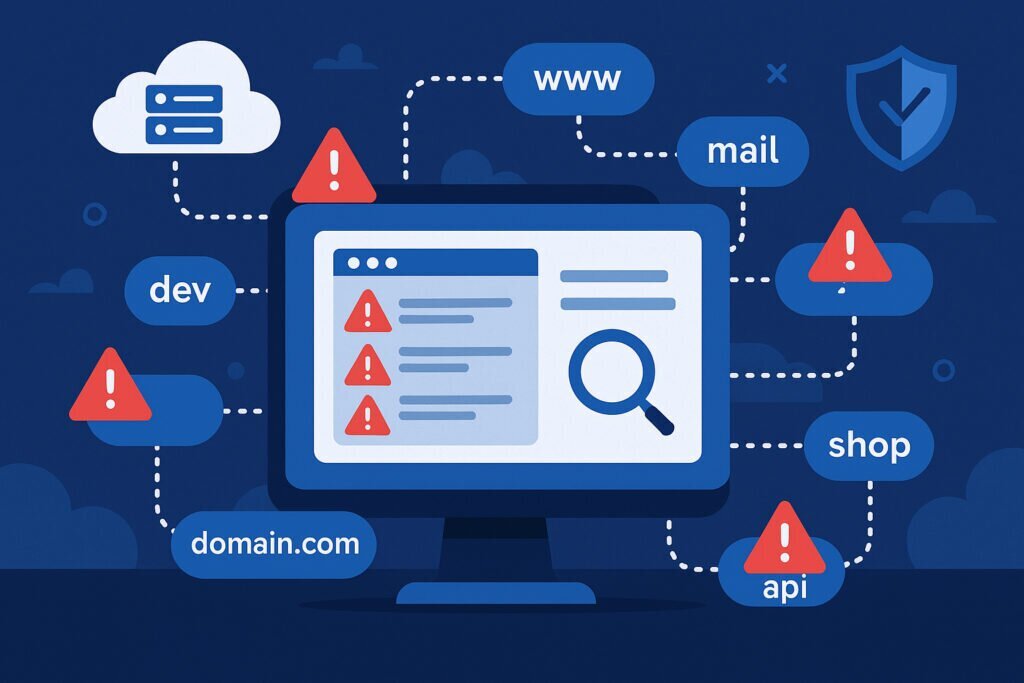
If you manage more than a handful of subdomains, you already know the feeling. You set up staging.yoursite.com for a quick test two years ago, someone on the marketing team spun up campaign.yoursite.com for a product launch that ended months ago, and there’s an api-old.yoursite.com that nobody remembers creating. The DNS records are still there, quietly pointing somewhere, and you have no clear picture of what’s actually live, what’s abandoned, and what might be a ticking security risk.
This article is for you if you’re responsible for keeping DNS infrastructure healthy across dozens or even hundreds of subdomains. Whether you’re a sysadmin, a DevOps engineer, or a business owner who ended up managing their own infrastructure, the goal here is simple: give you a practical framework for staying on top of DNS records before they become a problem.
Why Multi-Subdomain Environments Get Messy
The root cause is almost always the same. Creating subdomains is easy. Decommissioning them is nobody’s job.
In a typical organization, subdomains get created for staging environments, microservices, partner integrations, landing pages, internal tools, demo setups, and regional variations of main sites. Over a few years, a domain that started with www and mail can easily grow to forty or fifty subdomains. Some of these point to cloud services you no longer pay for. Some have A records pointing to IP addresses that were reassigned long ago. Some have CNAME chains that lead nowhere.
The problem isn’t complexity itself. The problem is that DNS management is often treated as a “set it and forget it” task, when it really demands ongoing attention.
The Real Risks of Neglected DNS Records
Let me share a situation I encountered. A company had a subdomain pointing via CNAME to an old Azure instance they had deprovisioned. Because the Azure resource name was released, anyone could have claimed it and served whatever content they wanted under that company’s domain. This is a classic subdomain takeover scenario, and it’s far more common than people realize.
Beyond takeovers, stale DNS records cause other headaches. Dangling MX records can lead to email being routed incorrectly or lost entirely. Missing or misconfigured SPF and DKIM records on subdomains that send email will tank your deliverability and can let attackers spoof messages that appear to come from your domain. Orphaned A records pointing to decommissioned servers may eventually resolve to someone else’s infrastructure entirely.
These aren’t theoretical risks. They happen every week to real organizations.
Step-by-Step: Getting Your DNS House in Order
Step 1: Discovery. Before you can manage anything, you need a complete inventory. Manual checks won’t cut it if you have more than ten subdomains. You need automated subdomain enumeration. Tools exist that combine certificate transparency logs, DNS brute-forcing, and passive reconnaissance to find subdomains you forgot about. A service like DNSVigil does this automatically and continuously, which matters because new subdomains can appear at any time if multiple people in your organization have DNS access.
Step 2: Audit every record. Once you have the full list, go through each subdomain and check what it resolves to. Is the target still a resource you own? Is the record type correct? Are there duplicate or conflicting records? Pay special attention to CNAME records pointing to third-party services, as these are the most common source of takeover vulnerabilities.
Step 3: Classify and prioritize. Group subdomains into categories: active and critical, active but low priority, inactive but intentional, and candidates for removal. This classification makes ongoing management far easier because you know where to focus your attention.
Step 4: Clean up. Remove DNS records for subdomains that no longer serve a purpose. This sounds obvious, but I’ve seen organizations hesitate for months because nobody is confident enough to delete a record. If you’ve done the audit properly, you’ll know what’s safe to remove. Do it.
Step 5: Set up continuous monitoring. A one-time audit is better than nothing, but DNS records can change or become problematic at any time. Automated monitoring that checks record health daily and alerts you to issues is what turns a reactive mess into a manageable system.
Common Myths About DNS Management
One misconception I run into frequently is the idea that if a subdomain isn’t linked from your main website, nobody will find it. Attackers use the same enumeration techniques available to anyone. Your hidden staging subdomain is not hidden.
Another myth is that DNS is “just infrastructure” and doesn’t need regular attention. In reality, DNS is one of the most targeted layers in modern attacks precisely because so many organizations neglect it.
Some people also believe that their hosting provider handles DNS security for them. Providers manage their own infrastructure, but the responsibility for your DNS records, what they point to and whether those targets are still valid, is entirely yours.
Practical Tips for Ongoing Management
Keep a living document or spreadsheet that tracks every subdomain, its purpose, who created it, and when it should be reviewed. This sounds basic, but almost nobody does it, and it saves enormous amounts of time during audits.
Restrict who can create DNS records. If everyone on the team can spin up subdomains without any approval, your inventory will grow uncontrollably. A simple request process goes a long way.
Schedule quarterly reviews. Even with automated monitoring, a human review every few months catches things that automated tools might miss, like subdomains that are technically functional but no longer serve any business purpose.
Pay attention to email authentication records on all subdomains, not just your primary domain. Attackers love to spoof messages from subdomains that lack SPF and DKIM because they know most organizations only configure these on the main domain.
Frequently Asked Questions
How often should I audit my DNS records? A thorough manual audit every quarter is a good baseline, supplemented by automated daily monitoring for critical changes.
What’s the fastest way to find all my subdomains? Automated discovery tools that combine multiple data sources give the most complete picture. Certificate transparency logs alone miss a lot. A dedicated monitoring service like DNSVigil runs continuous discovery so you don’t have to remember to check manually.
Is it safe to delete old DNS records? If the subdomain serves no current purpose and the target resource no longer exists, yes. The bigger risk is leaving the record in place, where it could be exploited.
Do I need to worry about subdomains that don’t host a website? Absolutely. Subdomains used for APIs, mail routing, internal tools, or anything else all carry the same DNS-level risks. A dangling CNAME is dangerous regardless of what the subdomain was originally used for.
The Bottom Line
Managing DNS records in a multi-subdomain environment isn’t glamorous work, but it’s essential. The organizations that avoid costly incidents are the ones that treat DNS as a living system requiring regular care, not a static configuration file you set up once. Start with a complete discovery, clean up what’s no longer needed, and put monitoring in place so you catch problems before attackers do. Your future self will thank you.