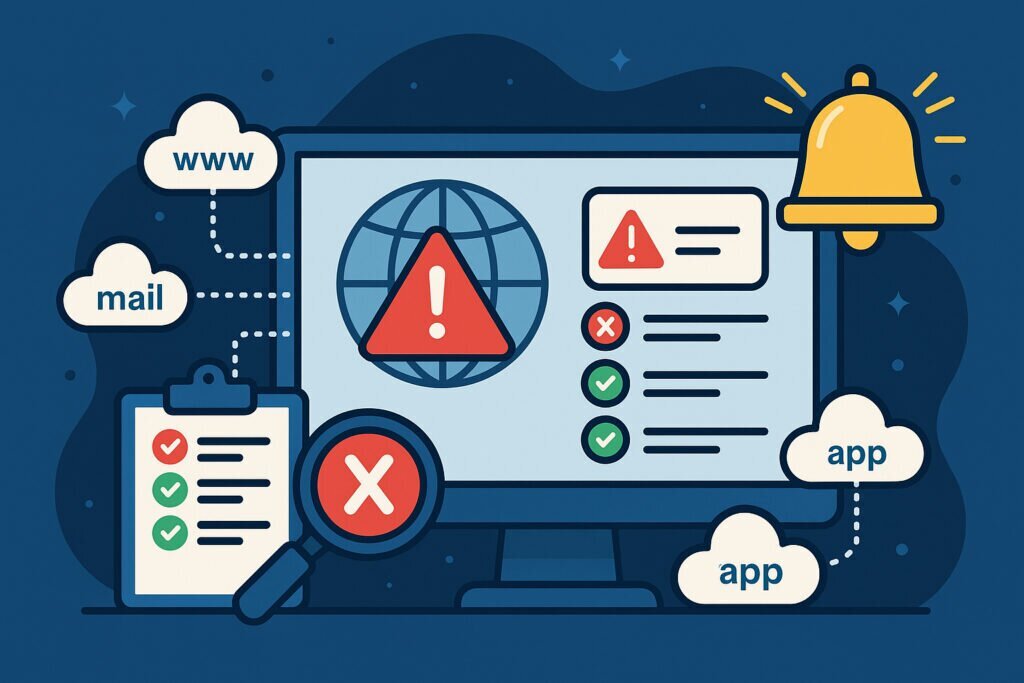
If you manage websites or online services for a living, you already know the sinking feeling. A client calls on Monday morning saying their site is down. You check the server — it’s fine. You check the application — running perfectly. Twenty frustrating minutes later you realize the problem is DNS. A record was changed, an entry expired, or some subdomain you forgot existed three years ago is now pointing into the void. The worst part? This could have been caught days ago with proper monitoring in place.
DNS problems are sneaky. They don’t announce themselves with a dramatic crash. They creep in quietly, and by the time someone notices, the damage is already done — lost traffic, bounced emails, or worse, a security breach. That’s exactly why early warning systems for DNS infrastructure aren’t optional anymore. They’re as essential as monitoring your servers themselves.
Why DNS Issues Are So Easy to Miss
Most teams monitor uptime, CPU usage, and disk space religiously. But DNS health? It tends to fall through the cracks. The reason is simple: DNS works silently in the background. When everything is fine, nobody thinks about it. When something breaks, it can look like a dozen other problems first.
Consider a typical growing company. Over the years, they spin up subdomains for staging environments, marketing campaigns, partner integrations, internal tools, and temporary projects. A dev creates staging.example.com for a client demo. The campaign team sets up summer2023.example.com for a promotion. The IT team configures vpn.example.com for remote access during a transition period. Fast forward a year, and half of these are forgotten. The services behind them have been shut down, but the DNS records are still live. Nobody notices because nobody is looking.
This is where things get dangerous. A dangling DNS record pointing to a decommissioned cloud instance can be hijacked. It’s called a subdomain takeover, and it happens more often than most people realize. An attacker claims the orphaned resource, and suddenly your subdomain is serving their content under your domain name. Your visitors trust it because it looks legitimate.
What an Early Warning System Actually Does
A proper DNS early warning system does three core things. First, it discovers what you actually have. Most organizations don’t have a complete, up-to-date inventory of their subdomains. An automated discovery process scans for all subdomains associated with your root domain, including the ones nobody remembers creating.
Second, it continuously monitors the health of every DNS record. This means checking that A records resolve to servers you actually control, that MX records point to functioning mail servers, that SPF and DKIM configurations are correct, and that CNAME chains don’t lead to dead ends. It’s not a one-time audit — it’s ongoing surveillance.
Third, it alerts you before problems escalate. A warning that your SPF record is misconfigured today prevents email deliverability issues tomorrow. A notification about a dangling CNAME today prevents a takeover attempt next week.
A Practical Approach to Setting This Up
I’ve spent years managing DNS across dozens of domains, and the hard lesson I learned early on was that manual checks don’t scale. I once missed a subdomain that had been pointing to an old hosting provider for over six months after we migrated. The hosting account expired, the IP got reassigned, and for a brief period our subdomain was resolving to someone else’s server entirely. It was pure luck that nothing worse came of it.
After that incident, I started building a more systematic approach. Here’s what works in practice.
Step one: get full visibility. You can’t protect what you don’t know about. Use subdomain enumeration to map out everything connected to your domain. Certificate Transparency logs, passive DNS databases, and active brute-force scanning each reveal different things. Combine them for the most complete picture.
Step two: establish your baseline. Document what each subdomain is for, what it should resolve to, and who owns it. This sounds tedious, but it’s the foundation everything else builds on. Without a baseline, you can’t detect drift.
Step three: automate monitoring. Set up checks that run at regular intervals — hourly at minimum for critical infrastructure, daily for everything else. Monitor not just whether records exist, but whether they resolve correctly and whether the destinations are still valid.
Step four: define your alert thresholds. Not every change is an emergency. A TTL adjustment is different from an A record suddenly pointing to an unknown IP. Classify your alerts so that critical issues wake someone up and informational changes get reviewed during business hours.
Step five: review and prune regularly. Schedule a monthly or quarterly review of your subdomain inventory. Remove records you no longer need. Every unnecessary DNS entry is attack surface you’re maintaining for no reason.
Common Myths Worth Dispelling
One persistent myth is that DNS monitoring is only for large enterprises with complex setups. In reality, even small businesses with a handful of subdomains are vulnerable. It only takes one forgotten record to create a security problem.
Another misconception is that SSL certificates alone protect you from subdomain takeovers. They don’t. If an attacker takes over your subdomain, they can issue their own certificate for it through services like Let’s Encrypt. The padlock icon will show up in the browser, making the hijacked subdomain look perfectly trustworthy.
Some people also believe that DNS issues are rare. They’re not — they’re just underreported. Many organizations discover problems only after they’ve caused visible damage, and even then, the root cause isn’t always traced back to DNS.
What Happens Without Early Warning
Without proactive monitoring, you’re essentially flying blind. Email deliverability drops because your SPF record got overwritten during a migration. A subdomain serving an old API starts resolving to an IP you don’t control. A partner integration breaks silently because a CNAME target changed on their end. These aren’t hypothetical scenarios. They happen every day to organizations that assume DNS takes care of itself.
The cost of reactive troubleshooting is always higher than prevention. Downtime, lost revenue, damaged reputation, and potential compliance violations all add up quickly. A proper early warning system turns these potential disasters into manageable notifications you handle before anyone else even knows there was a risk.
Frequently Asked Questions
How often should DNS records be checked? For business-critical domains, every hour at minimum. For less critical subdomains, daily checks are usually sufficient. The key is consistency — gaps in monitoring are gaps in your security.
Can I just use free DNS lookup tools manually? You can, but you won’t keep it up. Manual checking works for a one-time audit. For ongoing protection, you need automated monitoring that runs whether you remember to check or not.
What’s the first sign of a subdomain takeover risk? Usually it’s a CNAME or A record pointing to a resource that returns an error or a default provider page. If you see a “404” or a generic hosting provider landing page on one of your subdomains, investigate immediately.
Do I need to monitor internal-only subdomains too? Yes. Internal subdomains can be discovered through DNS enumeration just like public ones. If they resolve publicly, they’re part of your attack surface regardless of their intended audience.
DNS infrastructure is the foundation everything else runs on. Treating it as an afterthought is a risk most organizations can’t afford to take. Set up your early warning system now, while things are still running smoothly. It’s far easier to build the watchtower before the storm than during it.