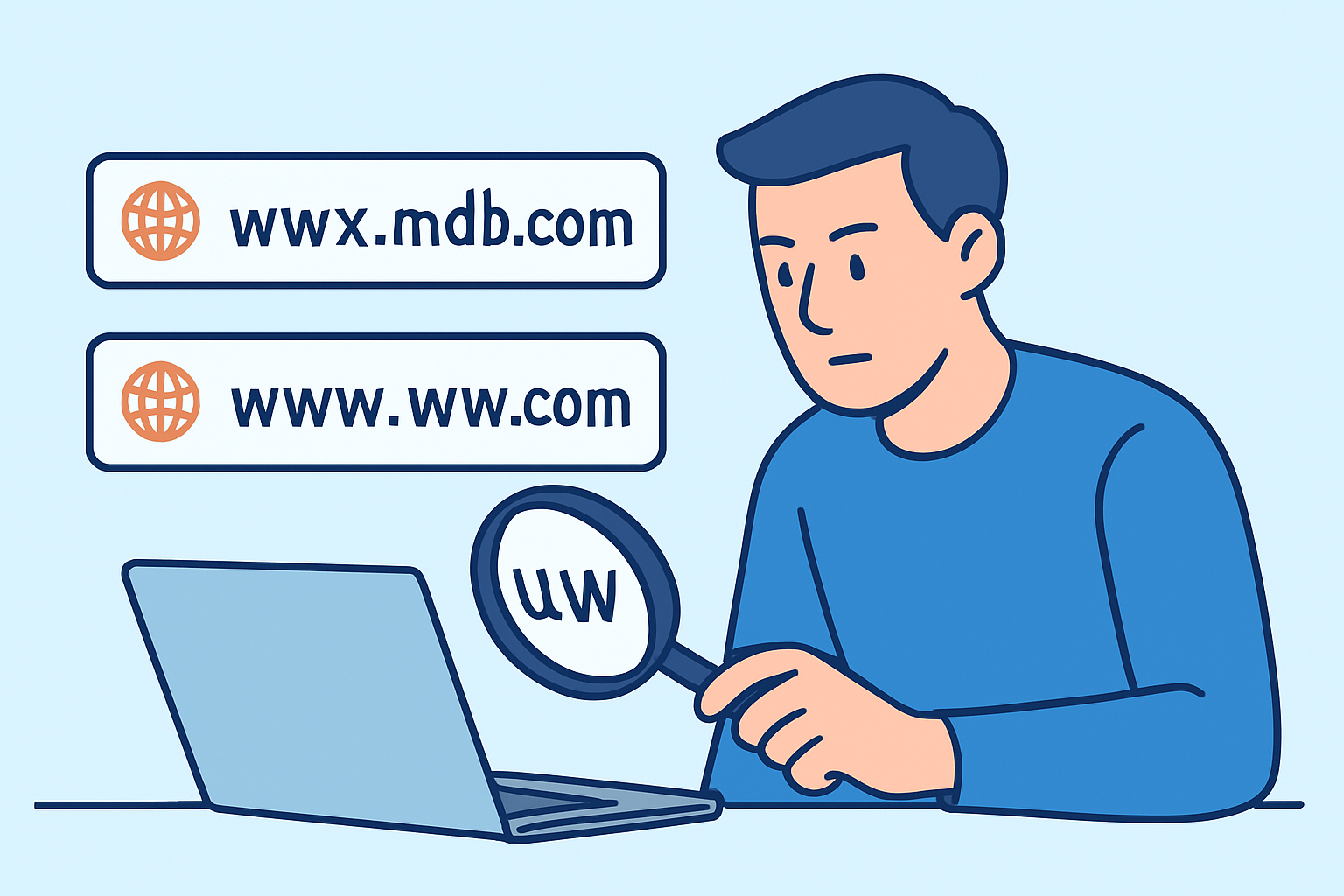
Homograph domains exploit a simple weakness in how humans read: two characters from different alphabets can look identical on screen while pointing to completely different Unicode code points underneath. For a security team, this matters because a domain like “аррle.com” — with a Cyrillic а substituted for the Latin one — can pass a visual inspection while routing victims to an attacker-controlled server, and no amount of staring at the address bar will catch it without the right tooling.
How Homograph Attacks Actually Work
The mechanism relies on Internationalized Domain Names (IDNs), standardized under RFC 3492 (Punycode) and RFC 5891 (IDNA2008). These standards let domains include non-ASCII characters — Cyrillic, Greek, Armenian, and others — by encoding them into an ASCII-compatible string prefixed with “xn--“. So “аpple.com”, where the first letter is Cyrillic U+0430 instead of Latin U+0061, actually resolves as “xn--pple-43d.com” at the DNS level, even though it renders identically in most fonts.
This isn’t typosquatting. Typosquatting relies on a user mistyping “gogle.com” instead of “google.com” — a keyboard error. Homograph attacks require zero typing mistakes from the victim; the string is visually perfect, just built from different code points. That distinction matters for defense: filtering for edit-distance typo variants won’t catch a homograph, because the character count and shape match exactly.
The most cited real-world demonstration came from researcher Xudong Zheng in 2017, who registered “аррӏе.com” using Cyrillic characters and showed it rendered as a clean Punycode-free “apple.com” in Chrome and Firefox at the time, bypassing the IDN spoofing protections both browsers had shipped. That single proof-of-concept forced both vendors to tighten their confusable-character detection logic within weeks.
Where the Confusable Characters Come From
Unicode Technical Standard #39 maintains a formal “confusables” table — pairs and groups of characters from different scripts that render near-identically depending on font rendering. Cyrillic contributes the highest volume of usable confusables against Latin script: а, е, о, р, с, х, and у all have Cyrillic look-alikes that are pixel-for-pixel indistinguishable in most sans-serif fonts at typical rendering sizes. Greek contributes fewer but still useful matches, like ο for o and ν for v.
Registrars generally don’t block cross-script registrations outright. ICANN’s IDN implementation guidelines recommend registries restrict a single domain label to characters from one script (a policy known as “single-script” or “whole-script confusable” blocking), and most gTLD registries — Verisign for .com, for instance — do enforce this at the label level. The gap is at the label boundary: nothing stops someone from registering a fully Cyrillic label that, character by character, mimics a fully Latin one. The label itself is internally consistent; it’s only confusable when compared against a different domain.
Detection: What Actually Catches These
Manual review does not scale here, and that’s the myth worth busting: many teams assume a sharp-eyed employee or a brand-monitoring intern scanning new registrations will catch a lookalike. In practice, humans fail this task reliably — Zheng’s demo fooled security researchers, not just casual users, and that was the point of publishing it.
What actually works is automated permutation generation compared against DNS registration and certificate transparency logs. The open-source tool dnstwist, maintained by Marcin Ulikowski, generates homograph, bitsquatting, and typo permutations of a target domain and checks which ones are actually registered and resolving. Feeding a domain like “yourcompany.com” through dnstwist’s `–format json` output against a scheduled job gives a practitioner a diffable list — new lookalike registrations show up as deltas from the prior week’s run rather than requiring anyone to eyeball a domain list.
Certificate Transparency logs are the other reliable signal. Because any publicly trusted CA logs every certificate it issues, a Cyrillic-heavy Punycode domain requesting a cert shows up in CT log feeds (crt.sh is the common query interface) often within minutes of issuance — frequently before the attacker has even finished building the phishing page behind it.
Practical Defenses for Domain Owners
A seasoned brand protection lead doesn’t try to register every possible homograph — the combinatorics make that impossible once you account for multi-script confusables and combining diacritics. Instead, the practical approach layers a few things:
Defensive registration covers only the highest-value, most visually convincing variants — typically the top 5-10 permutations dnstwist or similar tools flag as visually near-identical, plus the obvious TLD swaps (.co, .cm, .om for a .com brand).
Browser-side mitigation matters less than it used to, since Chrome, Firefox, and Safari now display Punycode (the raw “xn--” string) instead of the rendered Unicode whenever a domain mixes scripts in a way that fails their confusable checks — but this only triggers for mixed-script labels, not single-script Cyrillic-only labels that fully substitute for Latin ones, so it’s not a complete backstop.
Continuous DNS and certificate monitoring catches what registration and browser defenses miss. This is where ongoing visibility work — tracking new certificate issuance, watching for resolving lookalike domains, and correlating them against a known-asset inventory — turns a one-time audit into an early-warning system. Coverage here overlaps heavily with general subdomain squatting detection, since attackers increasingly combine homograph tricks with subdomain structures like “login.аpple-support.com” to add a false sense of legitimacy.
Email-specific protections matter too, since phishing is the dominant payload for homograph domains. A properly configured DMARC policy won’t stop a lookalike domain from being registered, but it does stop that lookalike from spoofing your real domain’s “From” header, forcing attackers to rely purely on the visual deception of the fake domain rather than combining it with header spoofing.
Common Mistakes Practitioners Make
The recurring failure pattern is treating lookalike domain monitoring as a one-time trademark filing exercise rather than a continuous process — a company registers the obvious variants once at brand launch and never revisits the list as new confusable character sets or TLDs become available. Another common mistake is trusting registrar-level “similar domain” alerts without verifying the character encoding yourself; some of these alerting services flag only ASCII typosquats and silently miss IDN-based homographs entirely. A third is focusing entirely on the root domain while ignoring that attackers building phishing infrastructure often need only a subdomain or a Punycode label under a completely unrelated parent domain to achieve the same visual deception, which is why DNS-level phishing prevention needs to extend past your own registered assets.
Frequently Asked Questions
Can antivirus or endpoint software block homograph domains?
Some endpoint products maintain blocklists fed by threat intelligence feeds, but this is reactive — a newly registered homograph domain typically isn’t flagged until it’s already been used in a campaign. It’s a supplementary control, not a primary defense.
Do all TLDs allow homograph registrations equally?
No. Registry policy varies significantly — some ccTLDs enforce stricter single-script rules than gTLDs, and a handful of registries (including some legacy ccTLDs) still allow mixed-script labels within a single domain, which makes them disproportionately popular for this kind of abuse.
Is Punycode display in the browser address bar enough protection on its own?
No. It only triggers when a label mixes scripts in a way the browser’s confusable-detection algorithm flags. A homograph domain built entirely from one non-Latin script that fully substitutes for Latin characters can still render as clean Unicode text with no Punycode warning, which is exactly what made the 2017 “аррӏе.com” case work.
Homograph domains succeed because they attack visual trust rather than technical infrastructure, which means the fix has to happen before a human ever looks at the address bar — through registration monitoring, certificate transparency checks, and DNS visibility that catches a resolving lookalike the moment it goes live rather than after the first phishing report comes in.