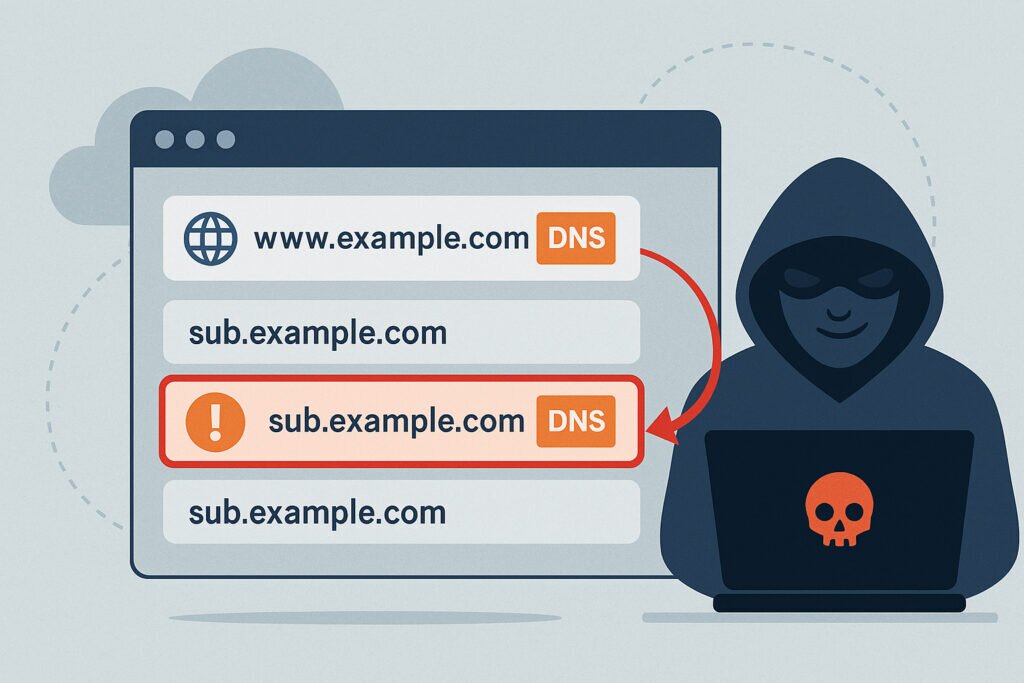
Misconfigured DNS records are one of the most consistently exploited entry points in real-world attacks. Understanding how attackers exploit misconfigured DNS records – and which record types carry the highest risk – gives security teams a concrete starting point for hardening their infrastructure before something goes wrong.
DNS misconfigurations are not rare edge cases. They accumulate steadily over years of infrastructure growth, team turnover, and cloud service adoption. By the time a security team runs a serious audit, it’s common to find dozens of records pointing to services that were decommissioned months or years earlier.
Why DNS Configuration Errors Are a Reliable Attack Surface
Attackers look for low-effort, high-reward targets. Misconfigured DNS records check both boxes. Unlike vulnerabilities that require exploiting a specific application flaw, DNS misconfigurations often require no technical sophistication to abuse – just the right observation and timing.
The attacker’s workflow is straightforward: enumerate subdomains, identify records pointing to services no longer under the target organization’s control, claim the external service endpoint, and start serving content or intercepting traffic under a trusted domain name. The entire process can be automated and run against large numbers of targets simultaneously.
What makes this particularly dangerous is that the victim’s DNS infrastructure is doing exactly what it’s configured to do. Nothing is technically broken. The misconfiguration is logical, not technical – a record that was correct when created has become unsafe over time.
The Most Dangerous Record Types and How They Get Abused
CNAME records pointing to deprovisioned cloud resources are the classic example. An organization spins up a staging environment on a cloud platform, creates a CNAME like staging.example.com pointing to a provider-assigned hostname, then shuts down the environment without removing the DNS record. The cloud hostname becomes available again. An attacker registers it, and now controls the subdomain completely.
Dangling CNAME records have been used to take over subdomains belonging to major organizations, including government agencies and Fortune 500 companies. The impact ranges from phishing pages under a trusted domain to cookie theft and credential harvesting.
MX records for abandoned email providers are less commonly discussed but equally dangerous. If an organization migrates email platforms and leaves old MX records in place, an attacker who registers the old provider account can intercept inbound email destined for that domain – including password reset links.
NS records delegating authority to expired domains represent the most severe misconfiguration. If a subdomain’s DNS has been delegated to a nameserver on a domain that has since lapsed, an attacker who registers that expired domain gains authoritative DNS control over the entire delegated zone. Every record under that subdomain is now under attacker control.
SPF records with overly permissive mechanisms – particularly +all or ~all on records that include too many third-party senders – effectively allow spoofing from any source. This is a configuration error rather than a stale record problem, but it’s just as damaging from a phishing and email fraud perspective.
How the Exploitation Process Actually Works
Understanding the attacker’s methodology helps clarify where defenses need to focus. The typical sequence looks like this:
1. Subdomain enumeration – using DNS brute force, certificate transparency logs, or passive DNS datasets to compile a list of subdomains associated with the target.
2. Record resolution – resolving each subdomain to check whether it currently serves content, returns an error, or produces a service-specific “not found” response that indicates the underlying service account no longer exists.
3. Service fingerprinting – identifying which cloud provider or SaaS platform the dangling record points to (GitHub Pages, Azure, Heroku, Fastly, Netlify, etc.).
4. Claiming the endpoint – registering a free account on the identified platform, creating a project or bucket matching the expected hostname, and verifying that the subdomain now resolves to attacker-controlled content.
5. Exploitation – serving phishing content, harvesting session cookies using the trusted subdomain’s origin, or using the compromised subdomain to send email that appears legitimate.
The time between steps 4 and 5 is often measured in minutes. That’s how quickly a forgotten DNS record can become an active threat.
A Common Myth Worth Correcting
Many teams believe that if a subdomain returns a 404 or displays an error page, it’s not exploitable. This is incorrect. The error page is often generated by the cloud platform itself – and is in fact the signal attackers use to confirm the service account is gone but the DNS record remains. A subdomain that shows a Heroku “no such app” error or an S3 “NoSuchBucket” response is actively vulnerable to takeover, not safely offline.
Another misconception is that internal or low-traffic subdomains aren’t worth attacking. Attackers use automated tooling that doesn’t distinguish between high-traffic marketing sites and obscure internal staging hosts. A subdomain used by 10 people is just as claimable as one serving millions of visitors – and often easier to take over because nobody notices.
Real-World Patterns Security Teams Keep Encountering
Campaign and marketing subdomains are a recurring problem. A team sets up promo.example.com for a product launch, uses a third-party landing page service, and when the campaign ends, the page is deleted but the DNS record stays. Six months later, nobody remembers it exists.
The same pattern appears with subdomain takeover attacks targeting developer tooling – CI/CD preview deployments, Slack app endpoints, demo environments. These are created quickly, often without formal change management, and frequently never cleaned up.
Mergers and acquisitions significantly amplify the problem. Inheriting another organization’s DNS infrastructure means inheriting their accumulated misconfigurations – often without documentation or institutional knowledge about which records are still needed.
Where Prevention Needs to Focus
Addressing DNS record misconfigurations that create security gaps requires both process and tooling. Process alone fails because DNS changes happen constantly and across multiple teams. Tooling alone fails if it only checks known records without discovering unknown ones.
The practical approach combines three elements:
– Continuous subdomain discovery to maintain an accurate, current picture of what records exist – including ones created by developers, marketing teams, or external vendors without going through IT.
– Automated health checks that detect when a record points to an unclaimed service endpoint, rather than just checking whether a hostname resolves.
– Alerting with context – not just “this record changed” but “this CNAME now points to a service that appears to be unregistered on provider X.”
Record cleanup should be part of standard project offboarding. The DNS record should be removed before the service account is cancelled, not after – otherwise there’s a window of vulnerability between deprovisioning and cleanup.
Frequently Asked Questions
Which DNS record types are most commonly exploited by attackers?
CNAME records pointing to deprovisioned cloud services are the most frequently exploited. MX records for abandoned email providers and NS records delegating to expired domains are less common but can have even more severe consequences, since they affect entire zones rather than individual hostnames.
How long does it typically take for a misconfigured DNS record to be exploited?
Automated scanning tools continuously monitor for vulnerable subdomains across the internet. Once a dangling record is publicly resolvable and points to an unclaimed service endpoint, exploitation can happen within hours – and in some cases within minutes of the service account being deleted.
Is it enough to monitor only the subdomains we know about?
No. A significant portion of exploitable DNS records belong to subdomains that have fallen out of organizational awareness – created by developers, agencies, or automated systems and never formally documented. Monitoring needs to include continuous discovery, not just checking a fixed list of known hostnames.
Key Takeaways
DNS misconfigurations are not a theoretical risk category – they are a practical, well-documented attack vector with a reliable exploitation path. The most dangerous records are often the quietest ones: subdomains nobody checks because nobody remembers they exist.
The gap between “this service was decommissioned” and “the DNS record was also removed” is where most subdomain takeovers begin. Closing that gap requires visibility across the full DNS infrastructure, not just the records currently in active use. Establishing that visibility – through continuous discovery and automated health monitoring – is the most direct way to reduce exposure to this class of attack.