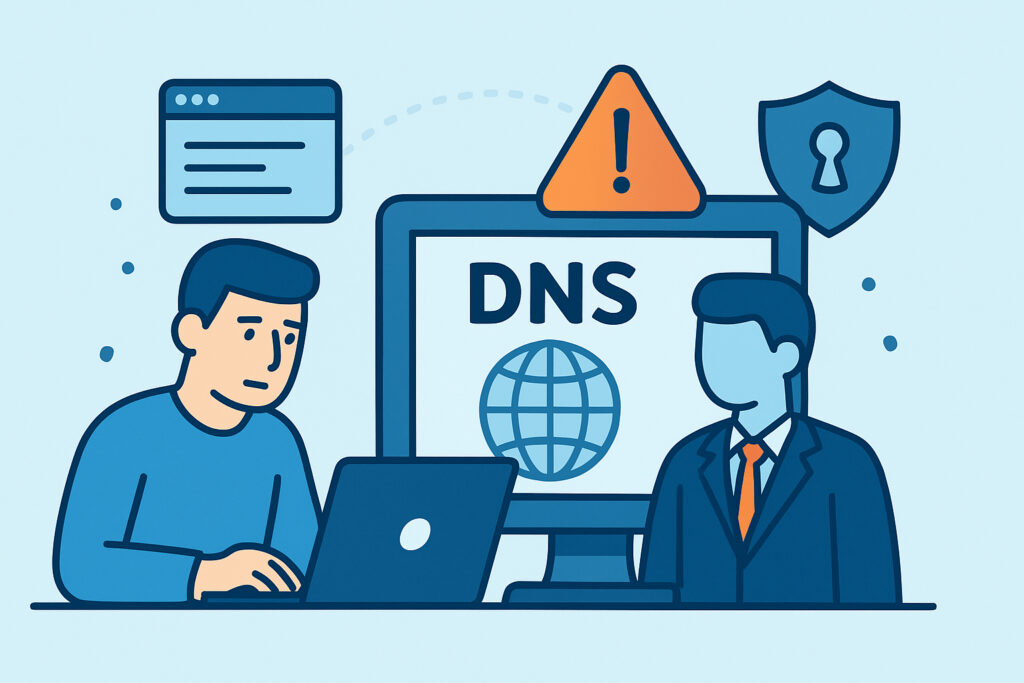
Managing your DNS attack surface becomes significantly harder the moment third-party vendors enter the picture. Every SaaS tool, CDN provider, email platform, or marketing automation service your organization onboards typically requires DNS changes – CNAME records, TXT verification entries, MX adjustments – and those changes accumulate over time into a sprawling set of dependencies that nobody fully tracks.
The problem isn’t vendor relationships themselves. It’s the DNS footprint they leave behind, which grows with each integration and shrinks with almost nobody.
What Vendors Actually Add to Your DNS Infrastructure
When a vendor gets onboarded, the DNS work happens fast and quietly. Marketing signs up for a new campaign tool – IT adds a CNAME. Customer success adopts a new helpdesk platform – someone adds an MX record and a TXT verification entry. The integration works, everyone moves on.
What gets left behind is a set of DNS records pointing to infrastructure the vendor controls. If that vendor gets replaced, acquired, or shut down, those records don’t automatically disappear. They sit in your zone, still pointing at services that no longer belong to you.
This is the core of the vendor DNS risk: you added the records, but you no longer control what they point to.
The CNAME Problem Is Bigger Than Most Teams Realize
CNAME records are the most common artifact of vendor relationships. They’re used for custom domains on support portals, landing page builders, CDN edge nodes, email tracking subdomains, and API gateways. A mid-sized organization might have 30–50 vendor-originated CNAMEs active at any given time.
When a vendor account gets cancelled – or when the vendor themselves winds down a service – those CNAME targets can become available for registration by anyone. An attacker who claims the underlying hostname can now serve content under your subdomain, with your SSL certificate, using your brand. This is a dangling CNAME, and it’s one of the most exploitable conditions in DNS security.
The myth worth busting here: many teams assume that if a subdomain isn’t listed anywhere public, attackers won’t find it. In practice, subdomain enumeration is automated, fast, and routinely performed by threat actors scanning for exactly these conditions.
How Vendor Sprawl Creates DNS Blind Spots
The deeper issue is organizational. DNS changes made for vendor onboarding often live in whichever system the person handling the integration had access to at the time – sometimes the registrar, sometimes a CDN control panel, sometimes a shared DNS provider managed by a contractor.
When that person leaves, or when the vendor relationship ends, nobody knows those records exist. They don’t appear in any vendor inventory. They’re not tied to any offboarding checklist. They just accumulate.
Cloud services compound this significantly. Many SaaS platforms provision subdomains on your behalf, create TXT records for domain verification, and set up email sending infrastructure – often without IT involvement. The business unit that signed the contract rarely documents the DNS changes required to make the tool work.
Common Vendor DNS Configurations That Introduce Risk
Understanding where the exposure typically lives helps prioritize what to check:
Email service providers: Vendors like marketing automation and transactional email platforms require SPF includes, DKIM TXT records, and sometimes custom MX entries for reply routing. If SPF includes reference a provider you’ve dropped, you’ve left a door open for spoofing from that provider’s infrastructure.
CDN and performance platforms: These almost always use CNAME delegation. If the vendor relationship ends but the CNAME stays, you’ve created takeover conditions on a subdomain that probably handles real user traffic.
Helpdesk and support tools: Custom support portals (support.yourdomain.com, help.yourdomain.com) are a common source of dangling records. These subdomains carry brand credibility – exactly what makes them valuable targets.
Tracking and analytics subdomains: Campaign tracking URLs, pixel hosts, and redirect domains often get CNAMEs that outlive the campaigns by years. Nobody remembers they exist.
Partner and integration endpoints: API subdomains set up for B2B integrations can remain active long after the partnership has ended.
A Realistic Vendor Offboarding Scenario
A company runs a customer engagement platform via a third-party vendor. The subdomain engage.company.com is CNAMEd to the vendor’s infrastructure. After 18 months, the contract isn’t renewed – the vendor gets replaced with an in-house solution. The CNAME record in DNS is never touched.
Six months later, the original vendor’s platform is acquired. The new owner decommissions legacy customer subdomains. The CNAME target becomes available. An attacker registers it within 48 hours, points it at a phishing page, and now controls content served under engage.company.com with a valid TLS certificate for that subdomain.
This isn’t hypothetical. Variations of this scenario appear in security incident reports regularly.
Steps to Reduce Vendor-Related DNS Risk
The remediation process is straightforward, but it requires visibility you probably don’t have yet.
Step 1 – Enumerate what’s there. Run a full subdomain discovery against your domain. Passive DNS records, certificate transparency logs, and brute-force enumeration together give you a realistic picture of your current DNS footprint. Don’t rely on internal documentation – it will be incomplete.
Step 2 – Map records to vendors. For each CNAME, TXT record, and MX entry, identify which vendor or system it belongs to. Check whether the relationship is still active. Check whether the target hostname is still registered and controlled by that vendor.
Step 3 – Check CNAME targets for takeover risk. Resolve each CNAME chain to its final destination. If any hop in that chain returns NXDOMAIN or points to a domain that’s expired or unregistered, flag it for immediate removal.
Step 4 – Establish offboarding DNS checklists. Every vendor offboarding process should include a DNS audit step. List all DNS changes made during onboarding and verify each one is cleaned up before the account closes.
Step 5 – Monitor continuously. Point-in-time audits go stale fast. Vendor DNS changes happen through shadow IT, departmental purchases, and contractor work. Continuous monitoring of your DNS zone catches new records as they’re added and flags anomalies before they become incidents.
Understanding the full scope of your domain portfolio’s attack surface is the foundation – without knowing what exists, you can’t protect it.
Frequently Asked Questions
How many DNS records does the average vendor relationship leave behind?
It varies by vendor type, but a single SaaS integration can easily generate 3–6 DNS records: a CNAME for the custom domain, one or more TXT records for domain verification, and entries for email authentication (SPF includes, DKIM keys). Over dozens of vendors, this adds up quickly.
Is it enough to check DNS records when a vendor contract ends?
Checking at offboarding is necessary but not sufficient. Vendors sometimes change their own infrastructure mid-contract, which can leave CNAMEs pointing at decommissioned targets before the relationship even ends. Continuous monitoring catches these conditions as they develop, not just at contract milestones.
What’s the fastest way to identify high-risk CNAME records?
Resolve each CNAME to its final target and check whether the destination is still controlled by an active vendor. Any CNAME chain that resolves to NXDOMAIN or to a domain that’s expired or available for registration is high-priority. Tools that automate this check across your full DNS inventory significantly reduce the manual workload.
Keeping Vendor DNS Risk Under Control
Third-party vendor relationships are a permanent feature of modern infrastructure – the goal isn’t to eliminate them but to maintain visibility over what they leave in your DNS. The key discipline is treating vendor onboarding and offboarding as DNS events, not just procurement events.
Build the habit of documenting every DNS change made for a vendor at the time it’s made. Run continuous discovery to catch what gets missed. And verify CNAME targets regularly – not just when something breaks, but as a standing operational practice. Vendor DNS hygiene is one of the lower-effort, higher-impact places to reduce real attack surface.