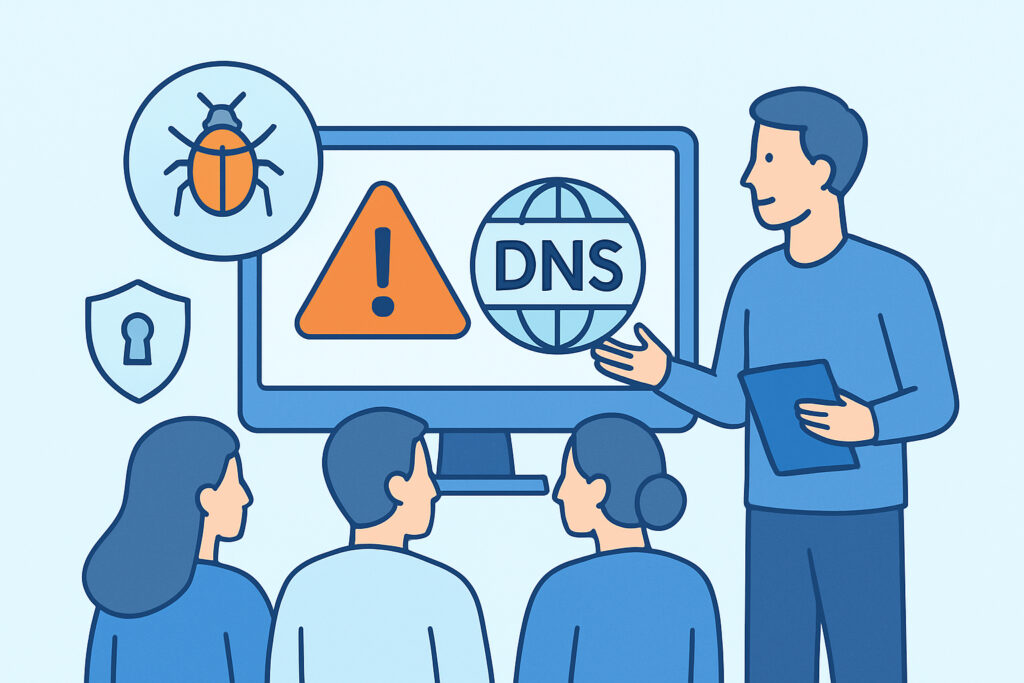
Getting your engineering team to recognize DNS security threats is less about lectures and more about repetition with real examples, and this article covers the specific training approach that actually changes behavior instead of producing a checkbox exercise. DNS sits underneath almost every service a company runs, yet most developers can go years without ever looking at a zone file, which means the first time they encounter a DNS-based attack in production is often the worst possible moment to learn.
Why DNS security training gets skipped in most onboarding programs
Security awareness training at most mid-market companies covers phishing emails, password hygiene, and maybe some social engineering scenarios. DNS rarely makes the list. Part of the reason is that DNS feels like “infrastructure team” territory, something the network admin handles, not something a backend developer or marketing coordinator needs to understand.
That assumption breaks down fast. A marketing team spinning up a Webflow or Unbounce landing page on promo.company.com creates a DNS record just as easily as a DevOps engineer provisioning an EC2 instance. Neither of them may realize that record becomes a liability the moment the campaign ends and the CNAME still points at a service nobody renewed.
Start with the threats your team will actually encounter
Generic “DNS is important” training doesn’t stick. Effective programs build around three or four specific attack patterns that map to real incidents:
Subdomain takeover happens when a DNS record (usually a CNAME) points to a third-party service — Heroku, GitHub Pages, Azure, AWS S3 — that has since been deprovisioned. An attacker registers the same resource name on that platform and now controls content served from your domain. Sub7 and similar research from 2016–2018 documented thousands of vulnerable subdomains across Fortune 500 companies, and the pattern hasn’t gone away; it’s just less publicized now because most large orgs have cleaned up the obvious cases.
DNS hijacking targets the registrar or DNS provider account itself, often through credential stuffing or social engineering support staff, and lets an attacker redirect an entire domain’s traffic. The 2019 Sea Turtle campaign compromised registrar accounts across telecoms and government domains in the Middle East and North Africa for over a year before detection.
Email spoofing exploits missing or misconfigured SPF, DKIM, and DMARC records, letting attackers send phishing email that appears to originate from your domain. This one matters to non-technical staff too, since it’s often sales or HR who get the “why did this fake invoice come from our CEO’s address” question from a customer.
Build training around your team’s actual DNS records
Abstract examples don’t land the way a walkthrough of your own zone file does. A seasoned security lead pulls the organization’s actual DNS export — every provider offers this, whether it’s Cloudflare, Route 53, or GoDaddy — and walks the team through it record by record during a 45-minute session. Which CNAMEs point to third-party SaaS tools. Which subdomains haven’t resolved to active content in over a year. Which ones nobody in the room can explain.
This exercise routinely surfaces 15–30 subdomains that even senior engineers didn’t know existed, particularly at companies with five or more years of history and multiple rebrand or acquisition events. Trace one or two of those back to their origin — a 2022 product launch, a contractor’s testing environment from a prior CTO’s tenure — and the abstraction of “dangling DNS is dangerous” becomes concrete.
Teach the specific signals, not just the concept
Once the team understands why this matters, training needs to cover what to actually look for. Give people a short, memorable list rather than a lengthy policy document:
A DNS record pointing to a hostname that returns a 404, “NXDOMAIN,” or a generic “this domain is not configured” page from AWS, Heroku, or Fastly is a red flag worth escalating immediately. A subdomain nobody on the team can attribute to an active project deserves the same treatment. Missing or “softfail” SPF records, and DKIM selectors that were never rotated, both indicate email authentication gaps. Any DNS change that wasn’t requested through the normal change process — even a TTL edit — should trigger a question before it triggers a shrug.
Role-play the escalation path explicitly. If a developer notices a stale CNAME during a Friday deploy, do they file a ticket, ping the security channel, or just leave it? Ambiguity here is where good intentions die. Define it in writing and repeat it during onboarding, not just once a year.
Common mistakes teams make when running this training
The most frequent failure is treating DNS training as a once-a-year slide deck buried inside a broader compliance module, so retention is near zero by month three. A second common mistake is training only the infrastructure or DevOps team, leaving marketing, sales ops, and customer success — the groups most likely to spin up throwaway subdomains for campaigns — completely unaware that DNS hygiene applies to them too. A third mistake, seen even in security-mature organizations, is teaching people to recognize threats without giving them a monitoring system to act on; a team that can spot a dangling CNAME in a training exercise but has no DNS monitoring in place will still miss it when it happens in production six months later, because nobody is looking.
Make detection continuous, not just educational
Training builds awareness, but awareness fades without reinforcement. Pair the training program with a recurring review cadence — quarterly is a reasonable minimum for most mid-sized organizations, monthly for anyone managing more than a couple hundred subdomains or working in a regulated industry. Automated subdomain discovery tools catch what manual review misses, since new subdomains get created between training sessions faster than any human can track by memory alone.
It’s worth busting a common misconception here: many teams assume DNS security is primarily about preventing outages, so they focus training on redundancy and failover. Availability matters, but the more common real-world incident is a forgotten, still-resolving subdomain quietly handing an attacker a foothold — no downtime, no alert, just a slow-burning reputational and phishing risk that goes unnoticed for months.
Frequently asked questions
How often should DNS security training be repeated?
Twice a year is a reasonable baseline for most organizations, with a lighter refresher during onboarding for new hires. Companies undergoing rapid hiring, an acquisition, or a major platform migration should increase that frequency, since those events are exactly when orphaned DNS records accumulate fastest.
Who should be included in DNS security training beyond the security and DevOps teams?
Anyone with the ability to create subdomains or DNS records, which in practice usually includes marketing operations, sales engineering, and any team using no-code landing page tools. If a role can spin up a subdomain without going through IT, that role needs at least the basic awareness training.
What’s the fastest way to know if the training actually worked?
Run a tabletop exercise a few weeks later using a real (but harmless) example, such as a deliberately stale test subdomain, and see whether the team follows the escalation path without prompting. If nobody notices or nobody knows what to do next, the training needs another pass.
Training sticks when it’s tied to a system the team checks regularly rather than a memory they’re expected to carry. Pair the workshop with a standing review of the organization’s own DNS records, updated as new subdomains appear, and DNS threats stop being an abstract compliance topic and start being something the whole team notices as part of normal work.