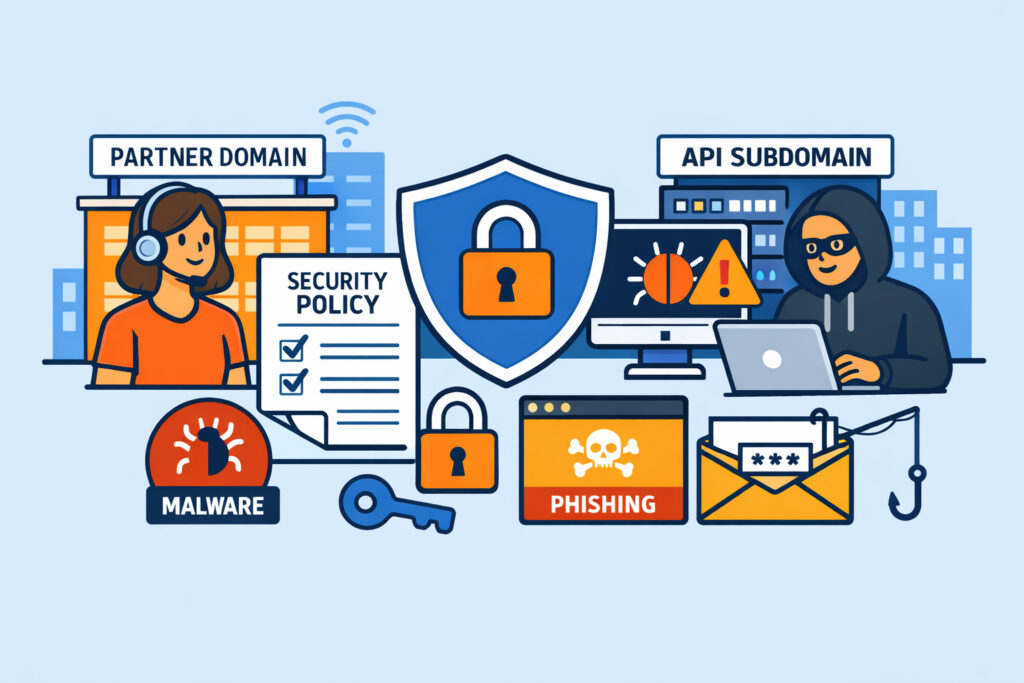
If you manage DNS for an organization that works with external partners or runs API services, you already know the subdomain count grows fast. Protecting partner and API subdomains from security threats is one of those tasks that rarely makes it onto anyone’s sprint board – until something breaks. A partner integration gets decommissioned, someone forgets to clean up the CNAME, and suddenly you have a dangling DNS record pointing at an IP address you no longer control. This article covers exactly how these subdomains become vulnerable, what attackers look for, and the practical steps you can take to lock them down before an incident report lands on your desk.
Why Partner and API Subdomains Are High-Value Targets
Most organizations treat their primary domain with care – SSL certificates are renewed, DNS records are reviewed, access is restricted. But subdomains created for partner integrations and API endpoints live in a gray area. They’re often set up quickly to meet a deadline, managed by a different team, and documented poorly if at all.
Consider a typical scenario. Your company integrates with a payment processor and creates payments-api.example.com pointing to their infrastructure. Two years later, you switch providers. The integration team removes the code references but nobody tells the DNS admin. That CNAME still resolves, and if the old target becomes available, an attacker can claim it and serve whatever they want under your domain name.
This is not theoretical. Subdomain takeover attacks targeting exactly this pattern have become one of the most common DNS security issues in organizations with more than a handful of external integrations. The risk compounds when you factor in that partner subdomains often have relaxed CSP headers, valid SSL certificates via wildcard certs, and implicit trust from users who see your brand in the URL.
The Specific Risks You Need to Address
Partner and API subdomains introduce several distinct threat vectors that differ from your typical forgotten marketing page.
Dangling CNAMEs after partner offboarding. When a partnership ends, the technical teardown almost never includes a DNS audit. CNAMEs pointing to partner-hosted services, CDNs, or cloud instances become orphaned. Attackers actively scan for these using the same enumeration tools security researchers use.
Overly permissive wildcard DNS records. Some teams configure wildcard records to simplify partner onboarding – any subdomain resolves without explicit configuration. This means an attacker who discovers your naming pattern can potentially exploit subdomains that were never intentionally created.
Missing or inherited SPF/DKIM/DMARC records. API subdomains that send transactional email on behalf of partners often lack their own email authentication records. If an attacker takes over such a subdomain, they can send phishing emails that pass basic email validation checks because the parent domain’s records don’t explicitly deny it.
Stale API gateway configurations. When an API version is deprecated but the subdomain remains active, the old endpoint might still accept requests with outdated authentication, exposing data or functionality that should have been retired. Understanding the full attack surface of your domain portfolio is the first step in identifying these gaps.
A Practical Protection Strategy
Securing these subdomains doesn’t require a massive project – it requires consistent process. Here’s what actually works in practice.
Step 1: Discover what you actually have. You can’t protect subdomains you don’t know exist. Run a full subdomain enumeration against every domain your organization owns. Automated discovery tools will find subdomains that nobody remembers creating – and that’s exactly where the risk lives. Pay special attention to naming patterns like api-, partner-, ext-, staging-, and v1/v2 prefixes.
Step 2: Map every subdomain to an owner. Each partner and API subdomain needs a responsible team or individual. If nobody can explain why a subdomain exists, that’s your first cleanup candidate. Create a simple spreadsheet or use your CMDB – the tool matters less than the discipline.
Step 3: Build offboarding into your partner lifecycle. When a partner integration is decommissioned, the DNS cleanup should be a mandatory checklist item, not an afterthought. Include it in the same runbook as revoking API keys and removing firewall rules.
Step 4: Monitor continuously. Manual audits catch problems months after they appear. Continuous DNS monitoring detects changes in real time – a CNAME suddenly resolving to a different IP, a record that stops responding, or a new subdomain appearing that nobody requested. DNSVigil handles exactly this by combining subdomain discovery with ongoing health monitoring, so misconfigurations that create security gaps get flagged immediately.
Step 5: Remove aggressively. When in doubt, delete the DNS record. If someone still needs it, they’ll tell you – probably within hours. A missing record causes a visible error. A dangling record causes an invisible vulnerability. The visible error is always preferable.
The Myth of “It’s Just an API Subdomain”
One misconception I see repeatedly is the belief that API subdomains are low-risk because “only machines talk to them.” This is dangerously wrong. API subdomains often handle authentication tokens, process sensitive data, and sit inside your domain’s cookie scope. A compromised API subdomain can be used to steal session cookies from your main application, host convincing phishing pages, or intercept OAuth flows. The mechanics of subdomain takeover attacks apply equally whether the subdomain serves a website or a REST endpoint.
Frequently Asked Questions
How often should we audit partner and API subdomains?
At minimum quarterly, but continuous automated monitoring is far more effective. Partner integrations can change status at any time – a provider shuts down, a cloud instance gets recycled, a trial expires. Waiting three months to discover a dangling record is three months of unnecessary exposure.
Should we use separate domains instead of subdomains for partner integrations?
Using a separate domain isolates the risk from your primary brand but adds management overhead and may reduce trust with end users. A better approach is to keep subdomains but enforce strict lifecycle management and monitoring. The real danger isn’t subdomains themselves – it’s forgotten subdomains in your infrastructure that nobody tracks.
Can wildcard SSL certificates make subdomain takeovers worse?
Yes. A wildcard certificate means any subdomain automatically gets valid HTTPS. If an attacker takes over a subdomain, they get a trusted green padlock for free – making phishing pages or malicious content appear completely legitimate to visitors and security tools alike.
Final Thought
The organizations that avoid DNS security incidents aren’t the ones with the most complex tooling – they’re the ones with the most consistent habits. Treat every partner and API subdomain as a potential liability from the day it’s created. Document it, assign an owner, monitor it, and have a clear process for removing it when it’s no longer needed. The cost of cleaning up a subdomain takeover is orders of magnitude higher than the cost of preventing one.