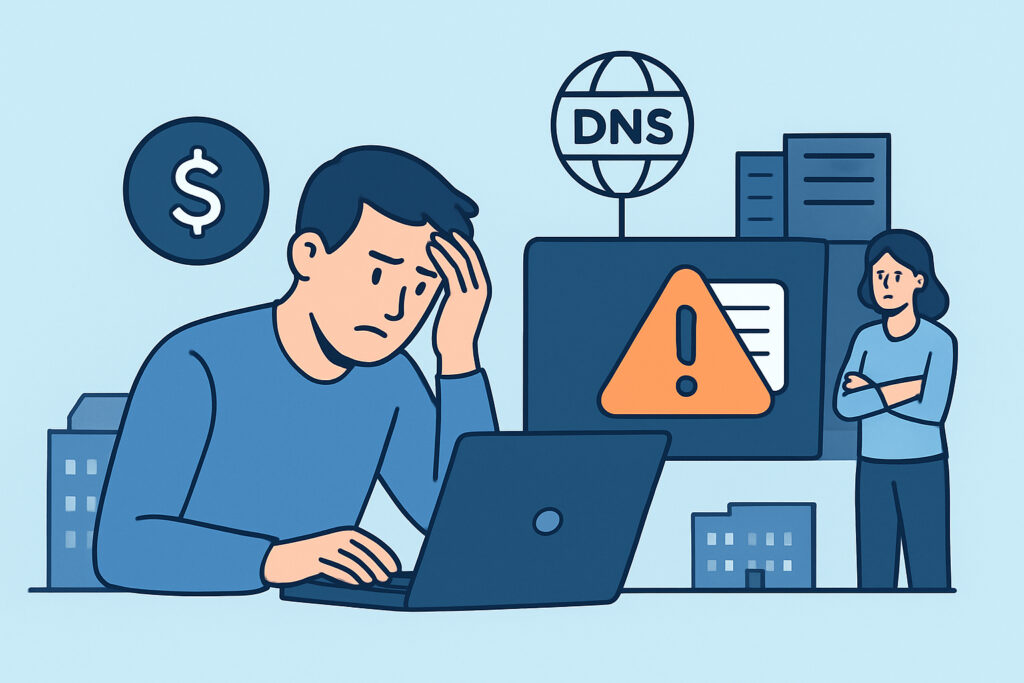
The hidden costs of poor DNS hygiene catch mid-market organizations off guard more often than any other infrastructure issue. DNS hygiene – the practice of keeping DNS records accurate, current, and free of dangerous misconfigurations – sits low on the priority list until something goes wrong. By then, the damage is already measured in hours of downtime, eroded customer trust, and compliance headaches that take months to untangle.
Why Mid-Market Organizations Are Especially Vulnerable
Mid-market firms occupy an awkward position in the DNS risk landscape. They’re large enough to have accumulated dozens or hundreds of subdomains over the years – development environments, marketing microsites, legacy portals, partner API endpoints – but often lack the dedicated security staff to track them all. Enterprise organizations have security operations centers. Small businesses have simple enough infrastructure to manage manually. Mid-market teams fall into the gap in between.
This sprawl happens fast. A marketing campaign launches with a dedicated subdomain. A developer spins up a staging environment. An acquired company brings its own domain portfolio. Each addition is tracked somewhere – maybe a spreadsheet, maybe a ticket, maybe nowhere at all. Over time, the DNS zone becomes a historical record of everything the organization has ever done online, most of it unmaintained.
The Real Price Tag of DNS Neglect
Downtime is the most visible cost, but rarely the most expensive one. When a misconfigured DNS record takes a customer portal offline, the incident response timeline looks roughly like this: the issue is spotted by a user complaint (30–90 minutes after it starts), escalated to IT (another 15–30 minutes), diagnosed as a DNS problem (20–60 minutes, since DNS is rarely the first place teams look), and then corrected and propagated (15–60 minutes depending on TTL values). That’s two to four hours of real downtime from a change that continuous monitoring would have caught in seconds.
The indirect costs run deeper. Sales demos that fail because a subdomain is down. Support tickets that spike because a customer-facing integration stops resolving. A developer who spends half a day troubleshooting what turns out to be a dangling CNAME pointing at a decommissioned cloud service.
DNS security incidents carry a financial impact that goes well beyond the technical fix. Regulatory penalties under GDPR and similar frameworks can follow if a misconfigured DNS record enables unauthorized access to customer data – and demonstrating that your DNS infrastructure was actively monitored is a significant factor in how regulators assess organizational responsibility.
Subdomain Takeover: The Cost That Doesn’t Show Up Until It’s Too Late
One of the most underestimated DNS hygiene risks in mid-market environments is subdomain takeover. The mechanics are straightforward: a subdomain still has a CNAME record pointing to a third-party service – a cloud storage bucket, a SaaS platform, a CDN origin – that has since been deprovisioned. An attacker can register that service under their own account and suddenly control what resolves at your subdomain, often with a valid TLS certificate and your organization’s branding intact.
The costs here are not just reputational. Customers phished through a subdomain that looks legitimate to every browser security check have no reason to suspect anything is wrong. The attack surface is completely invisible unless someone is actively watching for stale DNS pointers.
Stale DNS entries are the root cause of most subdomain takeover exposures. In mid-market organizations that handle DNS changes manually or through infrequent audits, these entries can persist for months or years after the underlying service was retired.
The Myth of the Quarterly DNS Audit
A common misconception is that a quarterly DNS audit is sufficient to maintain DNS hygiene. The reasoning sounds logical: review the zone file every three months, clean up anything outdated, and move on. In practice, this is not how DNS risk works.
A CNAME record pointing to an unclaimed S3 bucket can be exploited within hours of the bucket being released. A missing SPF record on a newly created subdomain can enable spoofed emails to reach customers the same day the subdomain goes live. The threat window between a DNS misconfiguration appearing and being exploited is far shorter than any periodic audit schedule can cover.
Continuous monitoring is not a nice-to-have for mid-market organizations – it’s the baseline. The DNS configuration that was clean at 9am on Monday can be compromised long before the quarterly audit runs in September.
Practical Steps to Improve DNS Hygiene
Getting DNS hygiene under control doesn’t require a complete infrastructure overhaul. The steps that make the biggest difference are:
1. Build a complete subdomain inventory. You can’t protect what you don’t know exists. Start with automated subdomain discovery to identify every subdomain currently resolving, including those the current team didn’t create. Many organizations find dozens of forgotten subdomains at this stage.
2. Audit CNAME targets against active services. Cross-reference every CNAME record with the list of services your organization currently uses. Any CNAME pointing to a service account you no longer control is an open takeover opportunity.
3. Verify email authentication records on all sending domains. SPF, DKIM, and DMARC records need to exist on every domain and subdomain capable of sending email – not just the primary domain. A subdomain without proper email authentication is an invitation for spoofing.
4. Set up continuous DNS monitoring with alerting. Any change to a DNS record – whether intentional or not – should trigger a review. This catches both accidental misconfigurations and unauthorized changes before they cause damage.
5. Formalize DNS cleanup as part of service decommissioning. When a service is retired, removing the associated DNS records should be a required step in the offboarding checklist, not an afterthought. Most stale DNS entries exist because nobody formalized this handoff.
For organizations scaling their infrastructure, DNS infrastructure security becomes significantly more complex as subdomain counts grow – and the cost of a manual approach compounds with every new service added.
Frequently Asked Questions
What is DNS hygiene and why does it matter for mid-market businesses?
DNS hygiene refers to keeping all DNS records accurate, current, and free from misconfigurations or stale entries. For mid-market businesses it matters because their DNS infrastructure has typically grown organically over years, accumulating forgotten subdomains and outdated records that create real security and availability risks without anyone noticing.
How much does a DNS-related security incident actually cost?
Direct costs typically include incident response labor (4–20 hours depending on severity), revenue lost during downtime, and any regulatory investigation costs. In cases where a subdomain takeover enables customer data exposure, GDPR fines alone can reach into the hundreds of thousands of euros for a mid-market firm – before factoring in remediation and reputational damage.
Can DNS hygiene be automated, or does it require manual review?
Automation handles the monitoring and detection side reliably – continuously checking for stale records, newly appeared subdomains, missing SPF or DKIM configurations, and CNAME targets pointing to unclaimed services. Human review is still needed to decide whether a record should be removed or updated, but the detection layer should never depend on manual effort.
Summary
Poor DNS hygiene is not a theoretical risk for mid-market organizations – it’s an operational cost that surfaces in downtime, security incidents, compliance exposure, and engineering hours spent on problems that continuous monitoring would have caught immediately. The quarterly audit model fails against threats that materialize in hours. Building an accurate subdomain inventory, monitoring for stale records and unauthorized changes, and enforcing DNS cleanup as part of service decommissioning are the three changes that close the most exposure fastest. DNS infrastructure is not static, and maintaining hygiene requires treating it that way.