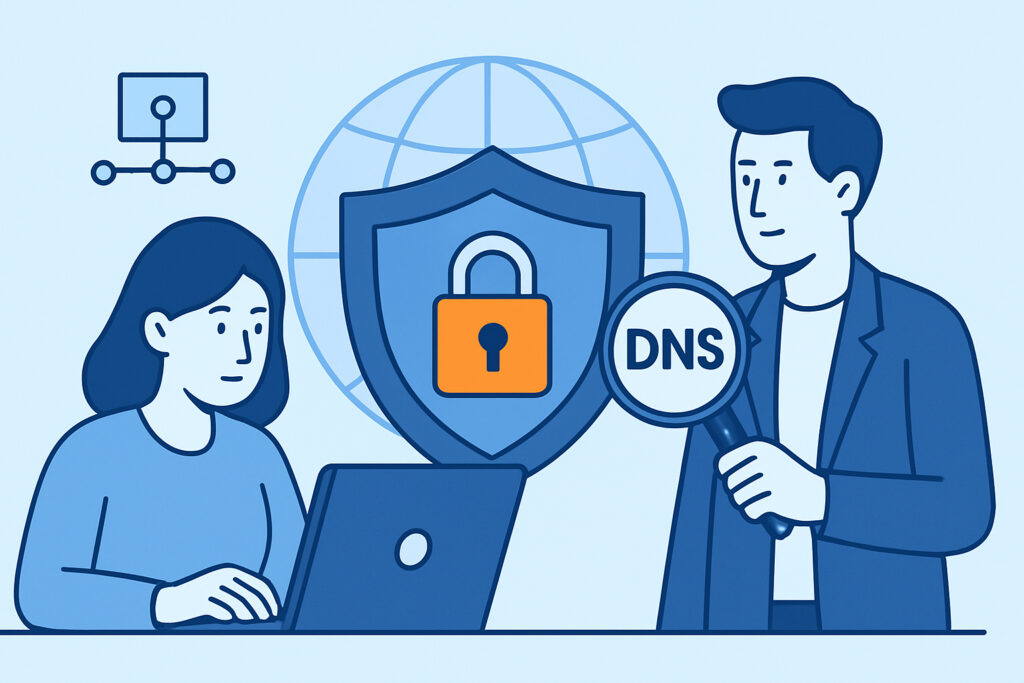
DNS has become a critical control point in zero trust security architectures, fundamentally changing how organizations verify and secure network communications. Zero trust security models require continuous verification of every connection and transaction, making DNS monitoring and configuration management essential components of a comprehensive security strategy.
Traditional network security operated on the assumption that internal networks could be trusted once perimeter defenses were bypassed. Zero trust architecture abandons this premise entirely, treating every DNS query, resolution, and connection as potentially hostile until verified through multiple security controls.
DNS as an Identity and Access Control Layer
In zero trust implementations, DNS serves as more than simple name resolution – it becomes an active security control that can authenticate, authorize, and audit network communications. Each DNS query provides an opportunity to validate the requesting entity, verify the destination’s legitimacy, and log the interaction for security analysis.
DNS-based access controls can block connections to unauthorized resources before they establish network sessions. When a user attempts to reach a restricted internal application, DNS resolution can be denied based on user identity, device posture, location, or time of access. This prevents lateral movement attempts that traditional firewalls might miss.
Modern DNS implementations in zero trust environments often integrate with identity providers to make resolution decisions. A contractor’s laptop might receive different DNS responses than a full-time employee’s workstation, effectively creating network segmentation through name resolution control.
Continuous Verification Through DNS Monitoring
Zero trust architectures demand real-time visibility into DNS infrastructure changes. Attackers frequently target DNS to establish persistence, redirect traffic, or exfiltrate data. Continuous DNS monitoring becomes essential for detecting these activities within the “verify continuously” principle of zero trust.
DNS monitoring best practices in zero trust environments go beyond traditional uptime checking. Security teams need immediate alerts when new subdomains appear, DNS records change unexpectedly, or resolution patterns indicate potential compromise.
Organizations implementing zero trust often discover that their DNS infrastructure contains numerous security blind spots. Development teams create test subdomains, marketing launches campaign sites, and business units establish partner integrations – all potentially outside the security team’s visibility. Each unknown subdomain represents a potential entry point that violates zero trust principles.
Addressing the Attack Surface Challenge
A common misconception is that internal DNS servers are inherently secure because they’re not internet-facing. Zero trust security recognizes that attackers already inside the network perimeter pose significant risks to DNS infrastructure. Malware can modify local DNS settings, create rogue DNS entries, or poison DNS caches to redirect legitimate traffic.
Building a complete digital asset inventory becomes crucial for zero trust implementation. Organizations cannot secure what they don’t know exists, and DNS provides the most comprehensive view of an organization’s network footprint.
Consider a scenario where a financial services company discovers 47 previously unknown subdomains during their zero trust DNS audit. Three of these subdomains pointed to decommissioned cloud instances, creating potential subdomain takeover vectors. Two others contained development APIs with default credentials, accessible to anyone who discovered the subdomain names.
DNS Security Controls in Practice
Implementing DNS security within zero trust requires several specific technical controls:
DNS-over-HTTPS (DoH) and DNS-over-TLS (DoT) encrypt DNS queries to prevent eavesdropping and manipulation. However, these protocols can also bypass corporate DNS policies if not properly managed. Zero trust implementations need to balance privacy protection with security visibility.
DNS filtering becomes more sophisticated in zero trust environments. Instead of simple blacklists, organizations implement contextual filtering based on user identity, device compliance status, and behavioral analytics. A user exhibiting suspicious activity might face more restrictive DNS policies until their access is re-verified.
Dangling CNAME records represent a particular challenge for zero trust implementations. These abandoned DNS entries can be exploited to bypass security controls by redirecting trusted domain names to attacker-controlled resources.
Split-horizon DNS configurations help implement network segmentation principles. Internal users receive different DNS responses than external users, effectively hiding internal resources while maintaining seamless access for authorized personnel.
Integration with Zero Trust Platforms
Modern zero trust platforms increasingly incorporate DNS security as a core component rather than an afterthought. DNS queries provide rich context about user behavior, application usage, and potential security incidents.
Machine learning algorithms analyze DNS query patterns to identify anomalous behavior. Sudden queries to suspicious domains, unusual subdomain enumeration attempts, or DNS tunneling activities can trigger automated response workflows within zero trust platforms.
DNS logging and analytics feed into Security Information and Event Management (SIEM) systems to correlate network activity with other security events. A failed login attempt followed by DNS queries for data exfiltration domains might indicate a compromised account attempting to establish covert channels.
Operational Challenges and Solutions
Implementing DNS security in zero trust environments creates several operational challenges that require careful planning and execution.
DNS performance can suffer under the weight of additional security checks and logging. Organizations need to balance security requirements with user experience, often implementing caching strategies and geographically distributed DNS resolvers to maintain acceptable response times.
Legacy applications may not support modern DNS security protocols or integration with identity providers. These applications require special handling within zero trust architectures, often through DNS proxying or application-specific security controls.
Change management becomes more complex when DNS modifications require security review and approval processes. Organizations need streamlined workflows that maintain security rigor while allowing necessary business operations to continue efficiently.
Frequently Asked Questions
How does DNS monitoring differ in zero trust versus traditional security models?
Zero trust DNS monitoring focuses on continuous verification and assumes potential compromise at all times. Traditional monitoring typically watched for outages or performance issues, while zero trust monitoring analyzes every DNS transaction for security implications, user context, and behavioral anomalies.
Can DNS-based security controls replace traditional network firewalls in zero trust architectures?
DNS controls complement but cannot entirely replace firewalls in zero trust implementations. DNS provides early-stage blocking and policy enforcement, but firewalls remain necessary for deep packet inspection, application-layer filtering, and protecting against attacks that bypass DNS resolution entirely.
What happens to zero trust security when DNS services become unavailable?
Zero trust architectures should include DNS redundancy and fail-safe mechanisms. Most implementations maintain local DNS caches and fallback resolvers to ensure continued operation during DNS service disruptions, though security policies may become more restrictive during these events.
Building DNS Security Into Zero Trust Strategy
DNS security cannot be an afterthought in zero trust architecture planning. Organizations need comprehensive visibility into their DNS infrastructure, automated monitoring for security threats, and integrated response capabilities that work seamlessly with other zero trust components.
The shift to zero trust represents an opportunity to modernize DNS infrastructure and eliminate accumulated technical debt. Organizations can consolidate fragmented DNS management, implement consistent security policies, and gain complete visibility into their network footprint through systematic DNS security implementation.
Success requires treating DNS as a critical security control rather than just a network service, with appropriate resources, monitoring, and governance processes to support zero trust security objectives.