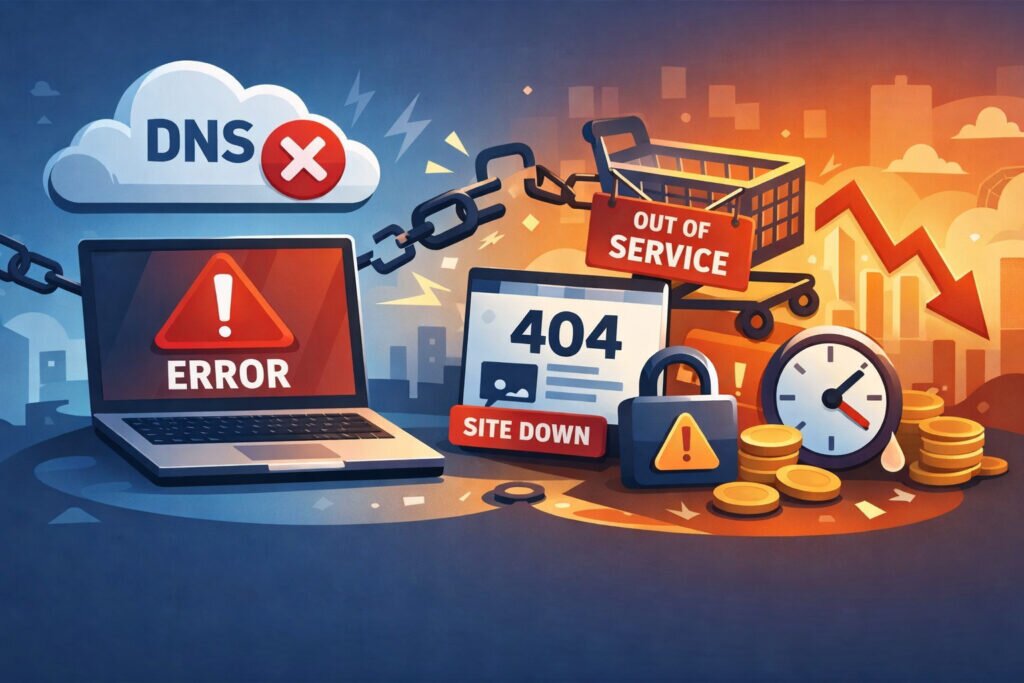
If you run an online business, the true cost of DNS downtime is almost certainly higher than you think. Most people calculate the lost revenue during the outage itself and move on. But DNS failures carry a long tail of hidden costs – from SEO damage to customer churn to broken internal systems – that can dwarf the immediate financial hit. This article breaks down every layer of that cost so you can make smarter decisions about protecting your infrastructure.
The Obvious Costs That Everyone Calculates Wrong
When DNS goes down, revenue stops. An e-commerce store doing $10,000 a day loses roughly $400 for every hour of downtime. That math is simple enough. But it’s also incomplete.
What most back-of-the-napkin calculations miss is the ripple effect. Your abandoned carts don’t magically recover when DNS comes back. Customers who hit an error page at checkout rarely return to try again – they’ve already found a competitor. A three-hour outage on a busy afternoon doesn’t just cost three hours of revenue. It costs days of recovery.
I’ve seen this play out with a mid-sized online retailer whose DNS provider had a brief hiccup on a Friday evening. Direct sales loss was around $1,200. The real damage showed up over the following week: support tickets from confused customers who thought the store had shut down, abandoned carts that never converted, and a spike in chargebacks from orders that partially processed before the outage. Total cost ended up closer to $8,000.
Customer Trust Disappears Faster Than You’d Expect
Here’s the part that doesn’t show up on your balance sheet for months. When a customer can’t reach your site, they don’t just wait and refresh. They leave and they remember.
Studies suggest that users who experience downtime are significantly less likely to return, even after service is restored. For subscription businesses, this is direct churn. For e-commerce, it’s lifetime value walking out the door. Lose 50 customers with an average lifetime value of $500 each, and you’re looking at $25,000 in long-term damage from a single DNS incident.
The worst part? You’ll never see those customers complain. They just quietly switch to whoever showed up in their next search result.
DNS Downtime Tanks Your SEO Rankings
This is the cost that keeps giving long after your DNS is back online. When Googlebot attempts to crawl your site and gets DNS errors, it treats that as a reliability signal. Not a good one. Repeated DNS issues can push your rankings down noticeably, and recovering lost search positions takes weeks or months – not hours.
If organic search drives a meaningful share of your traffic, even a modest ranking drop translates into sustained revenue loss. Sites with recurring DNS problems have seen organic traffic dip 10–15% for a month or more after the issue was resolved. You fix the DNS in an hour but pay the SEO penalty for sixty days.
Understanding the connection between DNS health and website reliability is critical if you depend on search traffic.
The Cascade Effect on Your Entire Infrastructure
DNS doesn’t just serve your website. It’s the foundation for email delivery, API endpoints, mobile app backends, CDN routing, and third-party integrations. When DNS breaks, everything breaks.
Your email stops flowing – which means customer communications, order confirmations, and password resets all fail silently. API partners get timeout errors and may automatically disable your integration. Your marketing team’s campaigns land on dead links. Cloud services you’re paying for sit idle, burning budget while generating zero value.
Each of these failures creates its own cost center: emergency IT hours, support team overtime, failed marketing spend, and partner relationship damage. A DNS outage that looks like a one-hour problem on paper can easily generate 40+ hours of cleanup work across multiple teams.
Brand Damage in the Age of Social Media
Downtime goes public fast. Frustrated customers post about it immediately. Competitors notice. Industry forums pick it up. For B2B companies, this is especially dangerous – a potential enterprise client Googling your company and finding recent downtime complaints could cost you a deal worth more than a year’s revenue.
The reputational math is harsh. You spend months building trust through consistent service, and a single prolonged DNS outage can undo a significant chunk of that goodwill in hours.
The Myth of “It Won’t Happen to Us”
One of the most common misconceptions is that DNS failures are rare events you don’t need to worry about. The reality is that most businesses experience multiple DNS-related incidents per year. Many go completely unnoticed because nobody is watching.
Another dangerous assumption: using a major DNS provider means you’re safe. Provider-level outages do happen, but the majority of DNS problems are self-inflicted – a deleted record, an expired domain, a misconfigured entry, or a forgotten subdomain still pointing to a decommissioned server. These are exactly the kinds of issues that stale DNS detection catches before they escalate.
Without proper DNS health monitoring, you’re essentially flying blind and hoping nothing breaks.
Prevention Costs a Fraction of a Single Outage
The economics here are not subtle. Continuous DNS monitoring costs a few dollars a month. A single outage can cost thousands in direct losses plus tens of thousands in hidden damage. The ROI on monitoring isn’t just positive – it’s overwhelming.
Good monitoring gives you instant alerts when DNS issues appear, often before end users are affected. It catches misconfigurations, tracks record changes, warns about expiring domains, and maintains a complete inventory of your subdomains. Knowing exactly what’s out there – including those forgotten test environments – is the foundation of preventing both downtime and security incidents.
Setting up proper DNS monitoring alerts is one of the highest-ROI actions any online business can take.
Frequently Asked Questions
How fast does DNS downtime start costing money?
Almost immediately. Unlike server-side issues that might degrade gradually, a DNS failure cuts off all access to your online services within minutes. Every customer, API call, and email delivery attempt fails at the DNS layer before it even reaches your server.
Doesn’t my hosting provider already monitor DNS for me?
Most hosting providers monitor server uptime – whether your server responds to requests. They typically don’t monitor DNS resolution separately. Your server can be perfectly healthy while a DNS misconfiguration makes it completely unreachable. These are different failure modes that require different monitoring.
Is the SEO impact really that severe?
It depends on frequency and duration, but yes – search engines treat DNS errors as a strong negative signal. A single brief outage probably won’t tank your rankings. Repeated issues or prolonged outages absolutely will, and the recovery timeline is measured in weeks, not hours.
The bottom line: DNS downtime is one of those risks where the visible cost is just the tip of the iceberg. The hidden costs – lost customers, SEO damage, infrastructure chaos, brand erosion – almost always exceed the direct revenue loss by a wide margin. Monitoring your DNS infrastructure continuously is not optional for any business that takes its online presence seriously.