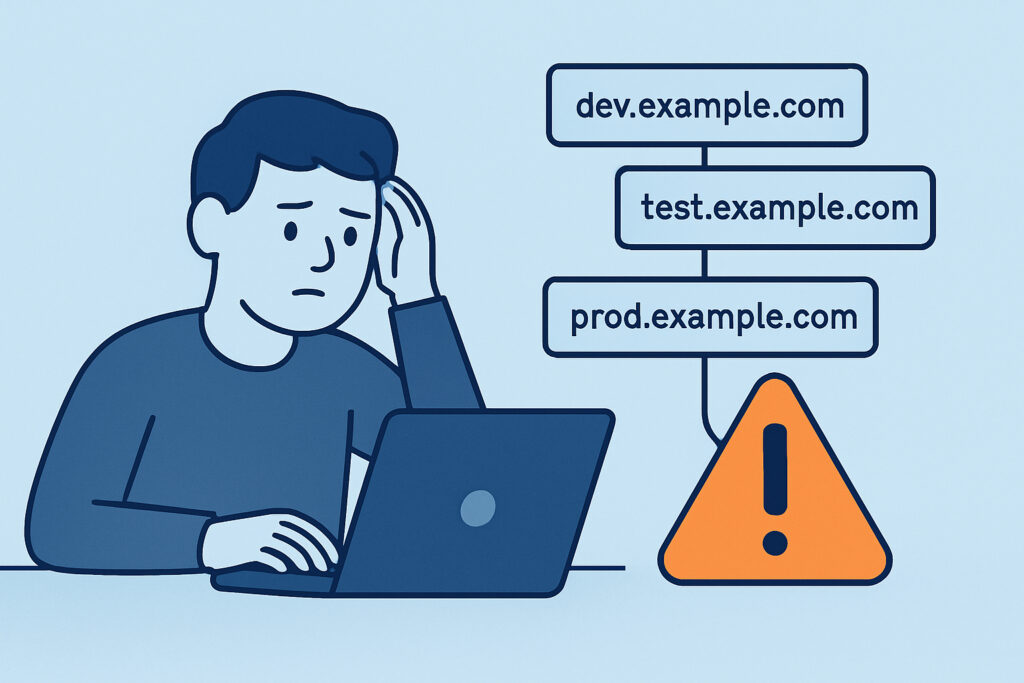
Development subdomains are a natural part of how engineering teams build software – staging environments, QA servers, feature branches, and integration test setups all need a home on the DNS. The problem is that these subdomains rarely get cleaned up with the same care that went into creating them, and what starts as a temporary convenience can quietly become a serious security liability.
How Dev Subdomains End Up Permanently in DNS
The typical pattern is familiar to anyone who has managed infrastructure for a growing team. A developer spins up dev.example.com to test a payment integration. The integration ships, the subdomain gets forgotten, but the DNS record stays. Six months later, the underlying service is deprovisioned – but the CNAME still points at a cloud provider endpoint that is now available for anyone to claim.
This is how subdomain takeover attacks work in practice. An attacker notices that dev.example.com resolves to a CNAME target that no longer exists on the provider side, registers or claims that endpoint, and suddenly controls a subdomain that carries your organization’s trust, cookies, and potentially its session handling.
The Lifecycle Problem Nobody Plans For
Most DNS hygiene discussions focus on production records – MX, SPF, DKIM, DMARC – because those directly affect email deliverability and security. Development subdomains fall through the cracks because they are provisioned casually, often by individual developers or DevOps engineers, without a formal ticket or decommission process.
A realistic scenario: a QA team sets up qa-uat.example.com for a client demo. The project wraps up, the demo environment is torn down, but the DNS record is never removed. Two years later, a security researcher finds that subdomain pointing to an unclaimed S3 bucket namespace. The organization has no record of who created it or why.
The window between service decommission and DNS record removal is where risk lives. In some organizations, that window is indefinite.
Why “Dev” Labels Offer False Confidence
A common misconception is that development subdomains are low-value targets. The logic goes: they contain no real user data, they are not publicly linked, so why would an attacker bother?
In reality, dev and staging subdomains often share the same root domain trust context as production. A browser will send production cookies to dev.example.com if the cookie scope is set to .example.com – which is standard practice. An attacker who controls a forgotten dev subdomain can potentially harvest session tokens from authenticated production users who trigger a cross-origin request to that subdomain.
Beyond cookie theft, a compromised dev subdomain can be used for phishing (it looks legitimate), bypassing email authentication checks, and serving malware from a trusted namespace. The security implications of abandoned test environments extend well beyond what most teams anticipate when they spin up a quick staging instance.
Mapping Your Actual Exposure
The first step is enumeration – understanding what subdomains actually exist under your domain. This is harder than it sounds. DNS zone files are often split across providers, different teams manage different subdomains, and acquisitions bring in domains nobody has mapped systematically.
Practical approach:
1. Run a full subdomain discovery against your primary domains, including historical passive DNS data.
2. For each active CNAME record, verify that the target still resolves and that your organization controls the endpoint.
3. Flag any subdomain pointing to a cloud service namespace – S3, GitHub Pages, Heroku, Azure, Fastly – since these are the most common takeover vectors.
4. Cross-reference your subdomain list against your current infrastructure inventory. Anything unaccounted for is a candidate for immediate investigation.
Forgotten subdomains create risk that compounds over time – the longer a dangling record persists, the more likely the downstream namespace becomes available for an attacker to claim.
What Good Decommission Practice Actually Looks Like
DNS record removal should be a mandatory step in every service shutdown checklist, not an afterthought. In practice, this means:
– Every new subdomain creation should be documented with an owner, a purpose, and an expected lifetime.
– Service shutdown runbooks must include a DNS cleanup step with explicit verification that the record has been removed.
– Staging and dev environments should use shorter TTLs so that when records are removed, propagation is fast.
– Regular automated scanning should flag CNAMEs and A records pointing to deprovisioned infrastructure.
The goal is to eliminate the gap between infrastructure shutdown and DNS cleanup. Even a 48-hour gap is enough time for an attacker monitoring these transitions to claim an endpoint and configure a redirect.
Why Continuous Monitoring Closes the Gap
Manual audits catch problems at a single point in time, but development subdomains are created and abandoned continuously. A quarterly DNS review will miss a subdomain that was created and left dangling in week two of the quarter. Detecting stale DNS entries early requires ongoing surveillance, not periodic snapshots.
Automated monitoring adds the layer that manual processes miss: immediate alerting when a CNAME target starts returning NXDOMAIN, when a subdomain’s IP address changes unexpectedly, or when a new subdomain appears under your domain without a corresponding provisioning event. That last signal matters – unauthorized subdomain creation is itself worth investigating, not just resolving.
Frequently Asked Questions
How quickly can an attacker exploit a dangling development subdomain?
In many cases, within hours of the CNAME target becoming available. Cloud service namespaces such as S3 buckets and GitHub Pages endpoints can be claimed almost instantly once the original owner releases them. Attackers actively monitor for these transitions using automated scanning tools.
Do internal or intranet subdomains carry the same risk?
Internal subdomains that are not publicly resolvable carry lower external risk, but they can still be exploited in internal network contexts or if a VPN or corporate access policy is misconfigured. The same decommission discipline applies – a dangling internal CNAME can be leveraged in lateral movement scenarios.
Is monitoring production subdomains enough to stay protected?
No. Development, staging, and QA subdomains frequently share root domain trust context with production environments, making them valid attack targets. A takeover on a forgotten dev subdomain can be just as damaging as one on a production endpoint if cookie scope or CORS policies are misconfigured.
The Fix Is Process, Not Technology
Development subdomains become production liabilities when the infrastructure they point to disappears but the DNS records stay behind. The solution is not technically complex – it is process and visibility. Enumerate everything under your domain, verify that every CNAME target is still under your control, and make DNS cleanup a non-negotiable step in your service shutdown procedures. Continuous automated monitoring closes the gap that audits leave open, catching dangling records as they form rather than months later when the damage is already done.