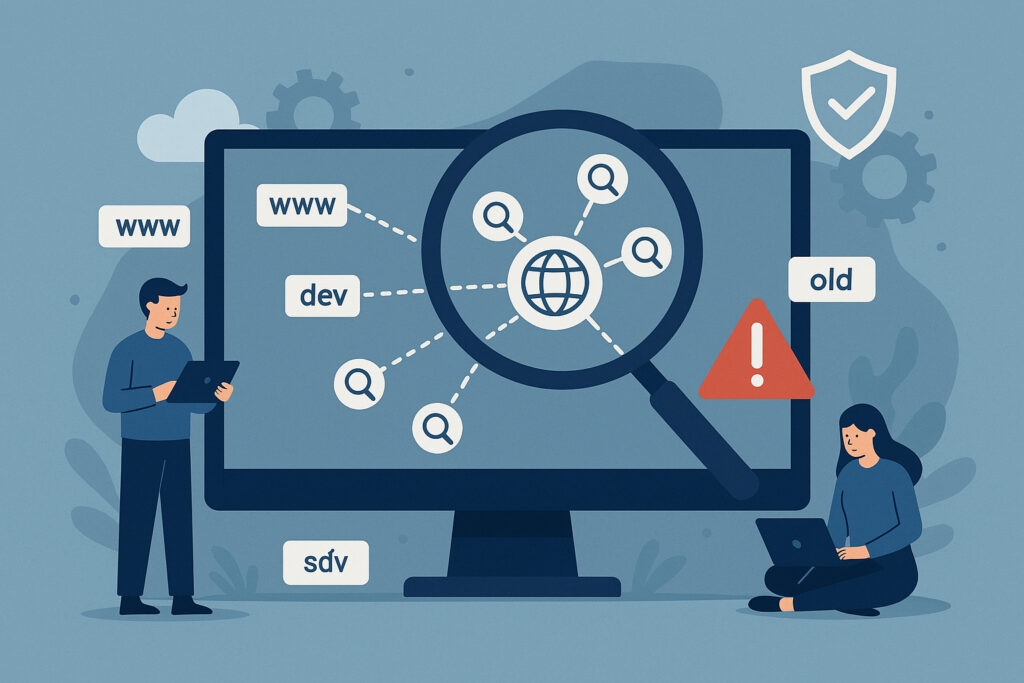
Most organizations have no idea how many subdomains they actually own. That statement might sound dramatic, but it’s frighteningly accurate. Between development teams spinning up test environments, marketing departments launching campaign microsites, and former employees who set up demo systems years ago, the average company’s DNS infrastructure resembles an iceberg – what you see on the surface is just a fraction of what exists beneath.
This blind spot isn’t just an organizational housekeeping problem. It’s a ticking time bomb that can compromise your security, damage your reputation, and cost you significant money when things go wrong. Let me explain why continuous DNS surveillance has become essential for every organization, regardless of size.
The Hidden DNS Infrastructure Problem
When I started working with mid-sized companies on their DNS security, I consistently found the same pattern. The IT manager would confidently tell me they had maybe 10-15 subdomains. After running a proper DNS enumeration, we’d discover 40, 50, sometimes over 100 active subdomains pointing to various resources – many of which nobody in the current organization even remembered creating.
This happens because DNS records are remarkably persistent. Someone sets up staging.yourcompany.com for a temporary project in 2019, the project ends, everyone moves on, but that DNS record keeps sitting there, pointing to a server that might not even exist anymore. Or worse, pointing to a cloud service instance that your organization cancelled months ago, which someone else can now claim and control.
The Real Cost of DNS Neglect
Subdomain takeover attacks have become increasingly common and devastating. The attack is elegantly simple: find an organization’s subdomain that points to a service they no longer control, register that service yourself, and suddenly you’re hosting content on what appears to be the victim’s legitimate domain. This can be used for phishing, malware distribution, or simply to embarrass the organization.
But security breaches aren’t the only concern. Broken DNS records cause tangible business problems every day. Email deliverability suffers when SPF and DKIM records are misconfigured or missing. Customer-facing services fail when DNS points to decommissioned servers. Partner integrations break when API endpoints change without updating DNS. Each of these issues costs time, money, and customer trust.
Why Manual DNS Audits Don’t Work
Some organizations try to address this through quarterly or annual DNS audits. An IT team member sits down, tries to document all known subdomains, checks their configurations, and produces a report. This approach has several fatal flaws.
First, it’s always out of date by the time it’s finished. New subdomains get created constantly, and DNS changes happen between audits. Second, manual audits only find what you already know about – they can’t discover the forgotten staging.api.yourcompany.com that someone created three years ago. Third, even the most diligent manual process can’t provide real-time alerts when something breaks or gets compromised.
I learned this lesson personally when working with an e-commerce company. They had done a comprehensive DNS audit just two months earlier, documenting everything carefully. But when their payment processing started failing mysteriously, we discovered that a critical subdomain’s DNS had been changed by accident during routine maintenance. Because they weren’t monitoring continuously, the problem went undetected for nearly 24 hours, costing them thousands in lost sales.
What Continuous DNS Surveillance Actually Means
Effective DNS surveillance involves three core components working together continuously. First, automated subdomain discovery that regularly scans for any subdomains associated with your primary domain, including ones you didn’t know existed. This uses various DNS enumeration techniques to build a complete picture of your DNS footprint.
Second, health monitoring that checks every discovered subdomain’s DNS configuration around the clock. This includes verifying that records point to valid, controlled resources, checking email authentication records like SPF and DKIM, and ensuring that SSL certificates are valid and current.
Third, immediate alerting when problems are detected. If a subdomain suddenly starts pointing to an IP address you don’t control, or if DNS resolution fails, or if critical records change unexpectedly, you need to know within minutes, not days or weeks.
The Specific Threats You’re Protecting Against
Subdomain takeover represents the most serious threat. This happens when your DNS points to a cloud service (like AWS S3, Azure, or Heroku) that you’ve cancelled or forgotten about. Attackers actively scan for these opportunities, and once they claim the abandoned service, they effectively control that subdomain of yours.
DNS hijacking occurs when attackers gain access to your DNS provider account and modify records maliciously. Continuous monitoring detects these unauthorized changes immediately, allowing you to respond before significant damage occurs.
Dangling DNS records might seem harmless but create multiple problems. They can cause email delivery issues, break internal applications, confuse customers who encounter error pages, and generally create support headaches that waste valuable time.
Implementation Without Overwhelming Your Team
The good news is that implementing continuous DNS surveillance doesn’t require hiring a dedicated security team or learning complex new tools. Modern DNS monitoring services automate the entire process, running scans in the background and only alerting you when something requires attention.
Start by getting a complete inventory of your DNS infrastructure. Many organizations are shocked by what they discover – subdomains they didn’t know existed, records pointing to long-dead services, missing security configurations. This initial discovery alone often justifies the effort.
Next, establish a baseline of what’s normal for your organization. Not every finding requires immediate action. Some organizations intentionally maintain hundreds of subdomains. What matters is knowing they exist and monitoring them for changes or problems.
Finally, set up alert thresholds that make sense for your team. You want to know immediately about serious issues like potential takeovers or missing DNS records, but you don’t want to be flooded with low-priority notifications that create alert fatigue.
Common Misconceptions About DNS Security
Many organizations assume their DNS provider handles security automatically. While reputable providers do protect their infrastructure, they can’t tell the difference between you legitimately changing a DNS record and an attacker doing so with compromised credentials. They also can’t know whether that subdomain pointing to a third-party service is still under your control.
Another misconception is that DNS surveillance is only necessary for large enterprises. In reality, smaller organizations often have messier DNS configurations precisely because they lack dedicated infrastructure teams. A 50-person company with 80 forgotten subdomains faces the same risks as a Fortune 500 corporation.
Some technical teams believe they can handle this with custom scripts. While possible, maintaining reliable DNS monitoring requires constant updates as new attack vectors emerge and DNS technologies evolve. The time investment rarely makes sense compared to using a dedicated service.
The Bottom Line
DNS infrastructure forms the foundation of your entire online presence, yet it’s often the most neglected aspect of organizational security. Every subdomain represents a potential entry point for attackers or a point of failure for your services. Without continuous surveillance, you’re essentially hoping that nothing has gone wrong in the shadowy corners of your DNS configuration.
The organizations that take DNS surveillance seriously aren’t paranoid – they’re realistic about modern threat landscapes and the complexity of maintaining digital infrastructure. They understand that you can’t protect what you can’t see, and continuous DNS surveillance provides the visibility needed to maintain both security and reliability.
Implementing proper DNS surveillance isn’t about achieving perfect security – that’s impossible. It’s about maintaining reasonable visibility into your infrastructure, catching problems early, and reducing your attack surface to manageable levels. Given the relatively low cost and effort required compared to the potential consequences of DNS-related incidents, it’s one of the most practical security investments any organization can make.