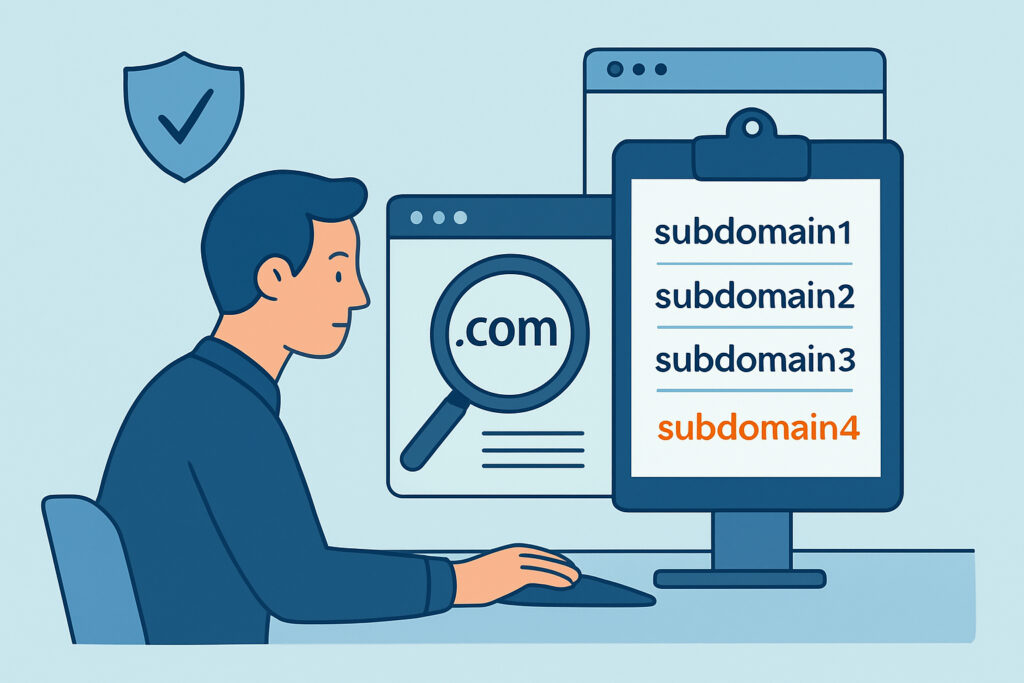
SOC analysts spend their shifts staring at alerts from firewalls, EDR platforms, and SIEM dashboards, but the attack surface they’re actually defending often extends far beyond what those tools were configured to watch. Subdomain discovery – the process of identifying every subdomain tied to an organization’s primary domains – is one of the most overlooked inputs into a SOC’s threat model, and that gap gets exploited more often than most teams realize. A forgotten staging subdomain or an abandoned marketing campaign page doesn’t show up in a vulnerability scan of production assets, yet it still resolves, still has DNS records pointing somewhere, and still carries the organization’s name.
Why subdomains fall outside normal SOC visibility
Most SOC tooling is built around known assets – the servers, endpoints, and applications that are formally tracked in a CMDB or asset inventory. Subdomains rarely make that list because they’re often created by teams outside of IT or security: marketing spins up a landing page subdomain for a campaign, a developer stands up a quick demo environment, a partner integration needs a dedicated API endpoint. Once the project ends, the DNS record frequently stays behind.
That’s the core problem. DNS is decentralized by nature – anyone with access to the zone can add a record, and nobody is required to remove it later. A SOC watching network traffic and endpoint telemetry has no visibility into a subdomain that nobody logs into anymore, because there’s no endpoint agent on it, no traffic pattern to baseline, and no ticket in the system tracking its existence.
How attackers use these blind spots
The most common exploitation path is subdomain takeover. A subdomain’s CNAME record points to a third-party service – a cloud hosting platform, a SaaS app builder, a CDN – and when that external resource is deleted or the subscription lapses, the DNS record often keeps pointing at the now-unclaimed resource. An attacker who finds this dangling pointer can register the same resource name on the provider’s platform and effectively take control of content served under the organization’s own domain.
From there, the subdomain can be used to host phishing pages that look completely legitimate because the URL bears the company’s real domain name, to harvest session cookies if the subdomain shares a parent-domain trust relationship, or to bypass content security policies that whitelist the entire domain. None of this requires breaching the internal network. It only requires finding a DNS record the organization itself forgot about.
What subdomain discovery adds to SOC operations
Bringing subdomain discovery into SOC workflows changes what “asset inventory” actually means. Instead of relying on manually maintained spreadsheets or whatever was documented during the last architecture review, automated discovery continuously enumerates DNS records tied to the organization’s domains and flags what’s actually live right now.
For a SOC, this closes several gaps at once:
Attack surface accuracy – analysts investigating an alert can check whether a suspicious domain is a legitimate but undocumented company asset instead of chasing false leads or, worse, dismissing something that turns out to be real.
Faster triage during incidents – when threat intel feeds flag a domain involved in phishing or malware distribution, having a current subdomain inventory lets the team immediately confirm whether it belongs to the organization.
Reduced dwell time for takeover risk – a subdomain pointing to a deprovisioned cloud resource can sit exposed for months before anyone notices. Continuous discovery catches the dangling pointer close to when it forms, not after an attacker has already claimed it.
This kind of ongoing enumeration is a natural extension of the broader asset discovery work security teams already own, since subdomains are simply another category of asset that needs an owner and a status.
Common misconception: “we already know our subdomains”
A persistent myth in security teams is that subdomain inventory is a solved problem because DNS records are documented during onboarding or infrastructure reviews. In practice, that documentation is a snapshot, not a living record. New subdomains get created constantly by non-security teams, and the review cycle that would catch them might happen once a year, if that.
It’s common during a discovery exercise to turn up two or three times more subdomains than what’s in the official inventory – old QA environments, one-off vendor integrations, regional marketing sites from campaigns that ended years ago. None of these are hypothetical risks; each one is a live DNS record that either points somewhere the organization controls or somewhere it doesn’t anymore.
Getting subdomain data into SOC workflows
The value of subdomain discovery depends on what happens with the data afterward. A one-time scan that produces a static report loses relevance within weeks, since new subdomains appear and old ones get decommissioned continuously. To be useful for a SOC, discovery needs to run continuously and feed into existing detection and response processes rather than living in a separate spreadsheet nobody checks.
That typically means piping subdomain and DNS health data into the same systems already used for correlation and alerting, similar to how organizations are integrating DNS monitoring into their SIEM workflows for other DNS-based signals. It also means assigning ownership – someone on the team needs to review new subdomains as they’re discovered and decide whether they’re expected, need to be decommissioned, or require follow-up with whichever business unit created them.
Frequently asked questions
How is subdomain discovery different from a vulnerability scan?
A vulnerability scan checks known hosts for weaknesses in software and configuration. Subdomain discovery finds hosts that exist in DNS but may not be in any known-asset list at all – it answers “what do we have” before a scanner can answer “is it secure.”
How often should a SOC re-run subdomain discovery?
Continuously, if possible, or at minimum weekly. New subdomains can appear at any time, and the window between a dangling DNS record forming and an attacker finding it can be short, especially for well-known cloud service naming patterns.
Does subdomain discovery replace the need for a documented asset inventory?
No. It’s a way to validate and continuously update that inventory rather than a replacement for the process of assigning ownership and lifecycle status to each asset once it’s found. For a deeper look at building enumeration into a repeatable process, see how subdomain enumeration surfaces what teams didn’t know existed.
Subdomain discovery isn’t a niche DNS concern – it’s asset visibility, and asset visibility is the foundation everything else in a SOC’s detection and response capability is built on. Treating it as a continuous, owned process rather than an occasional audit item closes one of the more exploitable gaps between what a security team thinks it’s protecting and what’s actually exposed under its domain name.