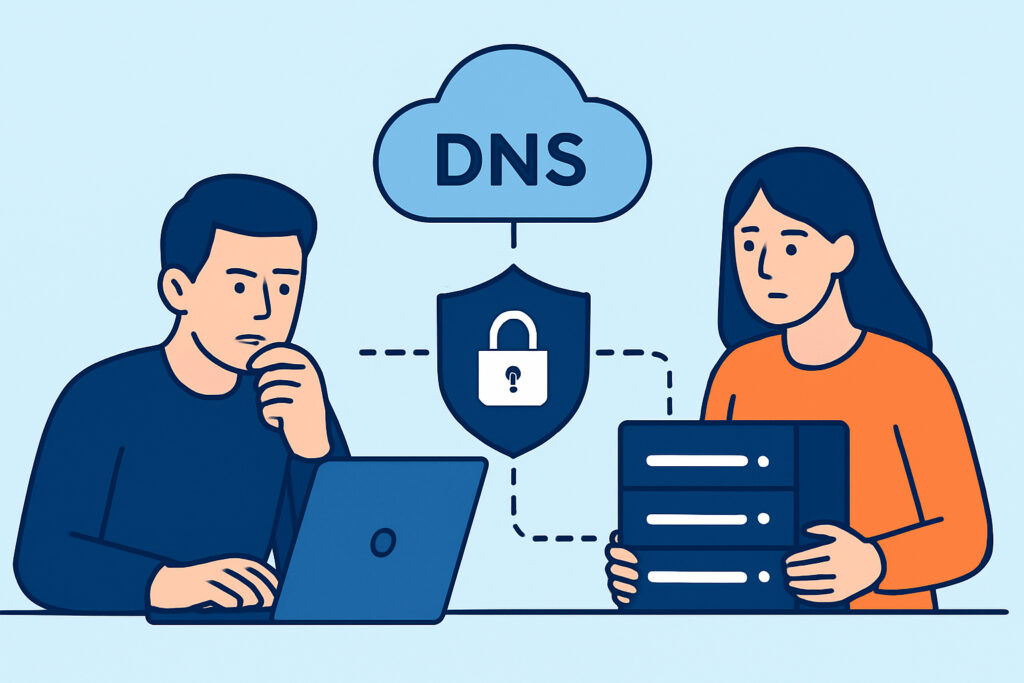
Most organizations don’t run their own authoritative name servers anymore – DNS hosting sits with a registrar, a CDN, or a dedicated DNS provider, and that shift brings a distinct set of security implications for external DNS providers that many teams never fully evaluate. Handing off DNS hosting reduces operational burden, but it also means a third party now controls one of the most sensitive layers of your infrastructure: the layer that decides where every request to your domain actually goes.
What Changes When You Hand DNS to a Third Party
When DNS is outsourced, the provider’s account security effectively becomes your account security. If someone compromises the login to that DNS dashboard, they can redirect mail, spoof your domain, or silently point a subdomain at infrastructure they control – often without touching anything inside your own network. This is a fundamentally different threat model than an on-prem breach, because the attack surface lives entirely outside your firewall, patching cycle, and internal monitoring tools.
It also changes who is responsible for DNS hygiene day to day. Internal teams create records for a new subdomain, a marketing landing page, or a temporary staging environment, then move on. The provider hosts whatever is entered into the zone file – it doesn’t know which records are still needed and which were abandoned six months ago.
The Real Risks of External DNS Providers
A few risk categories show up repeatedly in audits of externally hosted DNS:
Account takeover. Weak or shared credentials on the DNS provider’s portal are a single point of failure. Anyone with access can add, modify, or delete records for the entire domain.
API key sprawl. Many providers offer API access for automation. Keys get embedded in scripts, CI pipelines, or third-party tools and rarely get rotated, which quietly expands who can touch your zone.
Zone transfer exposure. Misconfigured name servers can allow unauthorized zone transfers, handing an attacker a complete map of your subdomains, mail servers, and internal naming conventions in one request. This is covered in more depth in DNS Zone Transfer Attacks and How to Prevent Them.
Dangling records after offboarding. When a CNAME points to a cloud resource hosted through the DNS provider’s ecosystem – a CDN endpoint, a load balancer, a SaaS integration – and that resource is decommissioned, the DNS record often survives. That’s a textbook setup for subdomain takeover.
Provider-side incidents. DNS providers are themselves targets. A breach or outage at the provider level affects every customer on that infrastructure simultaneously, which is why relying on a single provider without any independent visibility into your own records is risky.
How Third-Party Dependency Expands the Attack Surface
Every vendor added to a DNS setup – a registrar, a CDN, a DNS-based email security tool, a managed hosting platform – is another party with some level of write access or influence over how your domain resolves. This is the same dynamic that plays out with any outsourced infrastructure, and it’s worth reading alongside How Third-Party Vendors Expand Your DNS Attack Surface for a broader view of vendor-related exposure.
A common mistake is treating the DNS provider relationship as “set and forget” once records are configured. In practice, teams change vendors, marketing launches campaigns on new subdomains through a different platform, and old integrations get replaced – but the DNS records tied to those services rarely get cleaned up in the same change cycle.
A Common Myth Worth Correcting
There’s a persistent assumption that a reputable, enterprise-grade DNS provider automatically means the domain is secure. That’s not accurate. The provider secures its own infrastructure – uptime, DDoS resilience, name server redundancy – but it has no visibility into whether an individual record still points to something you own. A well-run provider hosting a stale CNAME pointed at a deleted cloud bucket is just as exploitable as a poorly run one. Provider quality and record hygiene are separate problems, and solving one doesn’t solve the other.
Practical Steps to Reduce the Risk
1. Enforce multi-factor authentication and role-based access on the DNS provider’s admin console – not just a shared login.
2. Rotate and scope API keys used for automated record management, and audit which scripts or integrations still use them.
3. Review the full zone file on a set schedule, not just when something breaks. Flag any record pointing to infrastructure no one can immediately account for.
4. Confirm zone transfers are restricted to authorized secondary servers only.
5. Consider DNSSEC to protect against spoofing and cache poisoning between your provider and resolvers – the tradeoffs are outlined in DNSSEC Explained: Should Your Organization Implement It.
6. Keep an independent, continuously updated inventory of subdomains and their targets, separate from whatever the provider’s dashboard shows, so changes made through the provider don’t go unnoticed.
That last point matters more than it might seem. A provider’s dashboard reflects the current state of the zone, but it won’t alert when a record silently starts pointing to a decommissioned service, and it won’t flag missing SPF or DKIM entries as a security gap – it just hosts whatever is entered.
Frequently Asked Questions
Is it safer to self-host DNS instead of using an external provider?
Not necessarily. Self-hosting introduces its own burden – patching, redundancy, and DDoS protection – that most organizations aren’t equipped to handle better than a specialized provider. The security gap usually isn’t the provider itself, it’s the lack of ongoing oversight of the records hosted there.
Can a DNS provider be blamed for a subdomain takeover?
Rarely directly. Takeovers typically happen because a record was left pointing at a resource that was deleted or expired elsewhere, not because the provider mishandled the zone. The responsibility for cleaning up unused records sits with whoever manages the domain.
How often should DNS records be reviewed when using a third-party provider?
A quarterly review is a reasonable baseline for most organizations, with more frequent checks after any infrastructure migration, vendor change, or team reorganization – the moments when records are most likely to go stale.
Outsourcing DNS hosting is a sound operational decision for the vast majority of organizations, but it shifts – rather than removes – the security responsibility around DNS. The provider secures the pipes; the organization still owns every record flowing through them. Treating the zone file as living infrastructure that needs regular review, rather than a configuration set once at launch, is what actually closes the gap.